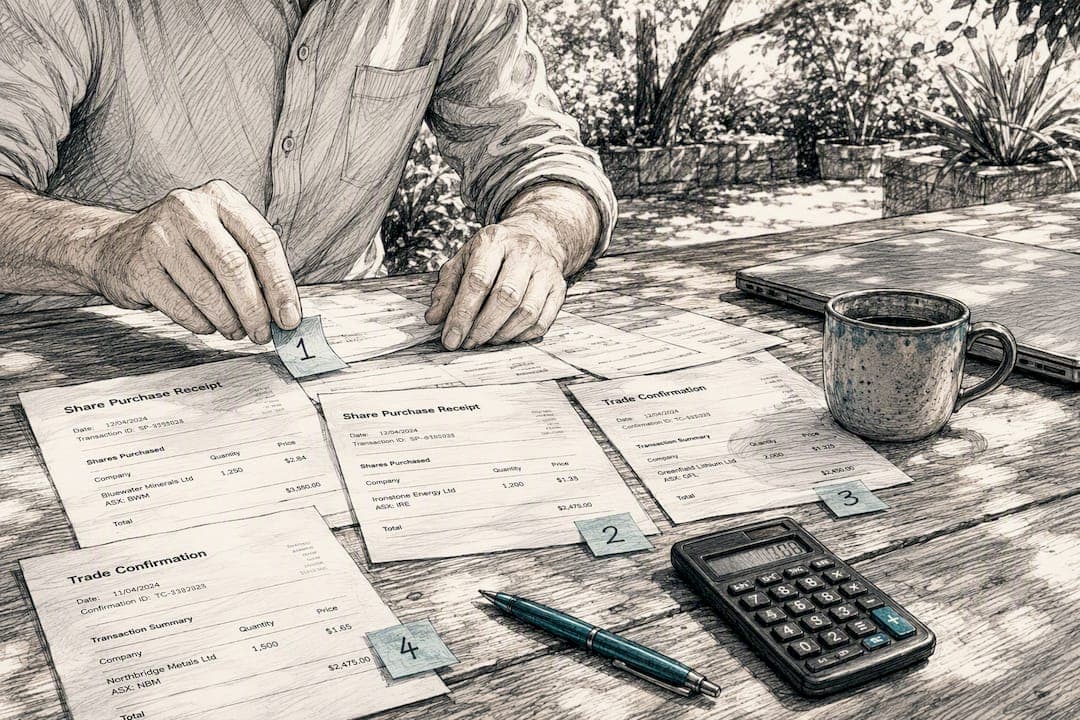
Selling or disposing of shares can create a taxable capital gain, and you calculate it as capital proceeds minus cost base, then apply whatever rate or discount your jurisdiction allows. That single formula sits underneath every capital gains tax question a shareholder ever asks. Whether tax is actually payable depends on the details: what you sold, when you bought it, what it cost you to buy and sell, and which reliefs apply where you live.
The immediate checks:
- Date of disposal — this determines which tax year the gain falls into and whether any long-hold discount applies.
- Purchase records — you need the original buy price, brokerage, and any adjustments from corporate actions.
- Transaction costs — brokerage and fees on both the buy and sell side reduce your taxable gain.
- Corporate actions — stock splits, mergers, and dividend reinvestment can quietly shift your cost base without you noticing.
In brief: A disposal of shares commonly triggers CGT when proceeds exceed the cost base. Exceptions, discounts, and exemptions vary significantly depending on where you're taxed, so the mechanics matter more than the headline rate.
Key Takeaways
Calculating CGT on shares correctly comes down to accurate cost base records, correct parcel identification, and applying the holding-period rule your own jurisdiction actually offers.
| Point | Details |
|---|---|
| Formula stays constant | Capital proceeds minus cost base gives your gain or loss, before any discount or offset is applied. |
| Parcels are separate assets | Shares bought at different times, including DRIP reinvestments, each carry their own cost base and holding period. |
| Holding period changes the bill | A long-hold discount, like Australia's 50% reduction after 12 months, can roughly halve the taxable amount. |
| Losses offset gains first | Capital losses reduce gains in the same year before any unused balance carries forward. |
| Records beat memory | Trade confirmations, statements, and corporate action notices are what substantiate your figures if questioned. |
| Gifts and inheritance shift timing | A gift is often treated as a disposal at market value, while inherited shares may keep the original cost base. |
Table of Contents
- How to work out a capital gain or loss on shares
- How holding period and calculation method change the taxable amount
- How capital losses work and how to use them to reduce tax on share gains
- When to report gains and what records to keep for share disposals
- Practical tax-planning moves investors use to manage CGT exposure
- How tax-aware modelling helps you plan for capital gains
- Specific rules for different types of shares
- Dividend reinvestment plans and how they affect your CGT calculation
- What happens to CGT when shares pass as a gift or inheritance
- What actually matters when you're calculating CGT on shares
- Frequently asked questions
- Sources
How to work out a capital gain or loss on shares
Every calculation starts with two numbers: what you got for the shares, and what they cost you to acquire and hold. The gap between them is your capital gain or capital loss, and getting each number right is where most investors trip up.
Capital proceeds is not just the sale price. It includes any other payments you received connected to the disposal, minus costs directly tied to selling (like brokerage on the sale). Cost base is broader than most people expect. It typically includes:
- The purchase price you paid for the shares.
- Brokerage and stamp duty paid on acquisition.
- Costs of owning the asset, where these haven't already been claimed as a tax deduction elsewhere.
- Costs incurred to establish, preserve, or defend your ownership.
There's also a reduced cost base, which comes into play specifically when you're calculating a capital loss rather than a gain. It excludes certain costs (like some ownership expenses) that are allowed in the cost base for gain calculations but not for loss calculations. This distinction trips up a lot of DIY investors because it means the same shares can produce a slightly different number depending on whether you're proving a gain or a loss.
Share parcels matter more than people think. If you bought 200 shares in March, then another 150 in August, and sold 150 in November, tax authorities generally treat each parcel as a separate asset. You need to identify which specific parcel you're disposing of, using whatever matching or lot identification rules your jurisdiction permits. Get this wrong and you can accidentally report the wrong holding period, or the wrong cost base entirely.
A worked example
Say you bought 500 shares at $20 each in February 2024, paying $45 in brokerage. Your cost base is the total amount paid including purchase price and brokerage.
When you sell all 500 shares, your capital proceeds are the sale price minus the selling brokerage costs.
Your capital gain before any discount is the difference between your capital proceeds and cost base.
That figure is your starting point before any long-hold discount, indexation, or offsetting losses get applied, which is exactly what the next section covers. Tax authorities including the Australian Taxation Office publish stepwise worked examples using this same structure, which is worth cross-checking your own numbers against.
Pro Tip: Keep a running spreadsheet with one row per parcel: purchase date, quantity, price per share, brokerage paid, and any corporate action adjustments. Pull the actual figures from trade confirmations and annual statements rather than trusting your memory or a rounded estimate from a brokerage app, because a $2 discrepancy per share across a large parcel adds up fast.
How holding period and calculation method change the taxable amount
How long you hold shares before selling can change your tax bill substantially, though the exact mechanism and labels differ by jurisdiction. Some systems distinguish short-term from long-term holdings and tax them at different rates. Others apply a flat percentage discount to gains on assets held beyond a set period. A few use indexation, adjusting the cost base for inflation over the holding period instead of applying a discount.
In the United States, for instance, short-term gains (assets held one year or less) are generally taxed as ordinary income, while long-term gains qualify for preferential tax rates. Australia takes a different approach: individuals who hold an asset for 12 months or more before disposal can apply a 50% discount to the taxable gain, provided they're not using the indexation method instead.
Here's why the choice of method matters in dollar terms. Take a capital gain of $3,903 calculated the way you saw above.
- Without any discount: the full $3,903 gets added to assessable income for the year.
- With a 50% long-hold discount applied: only $1,951.50 gets added to assessable income.
- The difference: $1,951.50 in gain effectively disappears from your tax calculation, purely because the shares were held long enough to qualify.
Some jurisdictions let taxpayers choose whichever method produces the better outcome, discount versus indexation, where both are available on the same asset. That choice isn't automatic. You typically have to calculate both ways and elect the one that reduces your liability, which is precisely the kind of comparison that's easy to get wrong doing it manually across multiple parcels.
Check your own jurisdiction's labels and thresholds before assuming any of this applies to you. The 12-month rule and 50% figure above are specific to Australian individual taxpayers. Other countries set different holding periods, different percentages, or no discount mechanism at all.
How capital losses work and how to use them to reduce tax on share gains
A capital loss happens when your cost base exceeds your capital proceeds on disposal, the mirror image of a gain. It's distinct from a trading or business loss, which arises from carrying on a business of buying and selling shares rather than holding them as investments. That distinction matters because the two loss types are usually treated under different rules and can't be mixed.
The general offsetting order works like this:
- Capital losses offset capital gains realised in the same tax year first.
- Any losses left over after that typically carry forward to future years, subject to your jurisdiction's specific rules on how long and how they can be applied.
- You generally can't use capital losses to offset ordinary income like salary or wages, only against capital gains.
A practical checklist for claiming a loss:
- Record the exact date of disposal and confirm it falls in the tax year you're reporting.
- Calculate the loss using the reduced cost base rules that apply to loss calculations specifically.
- Keep documentary proof if the loss arises from shares becoming worthless (delisting notices, liquidator statements, or administrator correspondence).
- Retain records of any corporate action, like a scheme of arrangement or capital reduction, that affected the disposal.
Pro Tip: Watch for wash-sale style rules and other anti-avoidance provisions that can disallow a loss if you sell shares purely to crystallise a tax benefit and buy back an equivalent parcel shortly after. Rules on what counts as a disallowed "superficial" transaction vary, so this is one area where checking your own jurisdiction's specific provisions before acting saves you from a loss claim getting knocked back later.
When to report gains and what records to keep for share disposals
You report a capital gain or loss in the tax year the disposal actually occurred, not the year you initially bought the shares and not the year money settles into your account if that differs from the disposal date. Missing this timing is one of the more common reporting errors, particularly with sales that settle just before or after a financial year boundary.
Most jurisdictions require the gain or loss to appear on a specific schedule or line of your annual return, and the exact form varies by country and sometimes by the type of asset. Confirming the right form for your situation before filing avoids having to lodge an amendment later.
Records worth keeping for every parcel of shares you own:
- Trade confirmations showing the exact purchase and sale dates, quantities, and prices.
- Broker or platform statements showing brokerage and fees charged on both sides.
- Corporate action notices, including stock splits, bonus issues, mergers, and buybacks.
- Dividend reinvestment plan statements, since each reinvestment typically creates a new parcel with its own cost base.
- Any prior worksheets or calculations you used to determine cost base, especially for older holdings where records are harder to reconstruct.
Tax authorities publish worksheets designed to walk you through exactly this process. The ATO's capital gain or capital loss worksheet is a useful template for the kind of line-by-line detail you should be capturing, even if you're not filing in Australia. Digital calculators and modelling tools can help aggregate parcel histories across a large portfolio, but treat their output as a starting point. Always verify the final figures against your own official statements before you file, since a tool can only be as accurate as the data fed into it.
Practical tax-planning moves investors use to manage CGT exposure
Investors who plan ahead rather than reacting at tax time tend to end up with materially lower bills, not because they're doing anything exotic, but because timing and sequencing decisions compound.
Tax-loss harvesting is the most common lever. This means deliberately realising losses on underperforming holdings to offset gains elsewhere in the same portfolio, in the same tax year. The sequencing matters: you generally want to identify your total realised gains for the year first, then look for loss positions that make sense to crystallise against them, rather than selling losers randomly throughout the year with no plan.
Timing sales across tax year boundaries is another straightforward technique. If you're close to a year end and expect your marginal tax rate to drop next year, or you want to use up an allowance that resets annually, deferring or accelerating a sale by a few weeks can change the tax outcome without changing the investment decision itself.
Tax-advantaged accounts and wrappers, where your jurisdiction offers them, shelter gains from CGT entirely or defer them until withdrawal. Superannuation in Australia, retirement accounts in other markets, and similar wrapper structures all work on this principle, though the specific rules, contribution caps, and withdrawal conditions differ enormously by country and by account type.
- Confirm eligibility and contribution limits before assuming a wrapper applies to you.
- Understand that the design of these systems, including rates, indexing, and discounts, has material effects on investor behaviour, which is exactly why the same portfolio can produce very different after-tax outcomes depending on how it's structured.
- Check for wash-sale or anti-avoidance rules before repurchasing a similar asset shortly after realising a loss.
Pro Tip: Model the after-tax outcome of a sale before you execute it, not after. Once a parcel is sold and the tax year closes, your options for changing the outcome disappear. Alphaiq's guide to capital gains tax strategies for self-directed investors walks through several of these techniques in more depth if you want to go further than the basics above.
How tax-aware modelling helps you plan for capital gains
Manually running the discount-versus-no-discount comparison, or checking whether this year or next year produces a better tax outcome, is tedious across even a moderately sized portfolio. Tax-aware modelling tools solve a specific problem: they project the net outcome after tax across different disposal scenarios, rather than leaving you to work out each option by hand.
What this kind of modelling actually produces for an investor:
- Projected after-tax proceeds for a sale, factoring in your specific cost base, holding period, and applicable discount.
- Breakeven sale dates, showing you the point at which holding longer starts to matter for tax purposes.
- Sensitivity analysis showing how the outcome shifts if the share price moves, or if your marginal tax rate changes between now and a later disposal date.
Comparing alternative disposal timings side by side, rather than guessing, is how investors avoid finding out at tax time that a slightly different sale date would have meant a materially different bill.
Alphaiq builds this kind of tax-aware modelling into a single view alongside superannuation, property, and retirement income projections, so a share sale decision isn't made in isolation from the rest of your financial position. For readers who want to model their own numbers rather than take a general example on faith, Alphaiq's CGT calculator walks through the specific inputs needed, and the CGT discount guide goes deeper into how the discount method plays out across different holding periods.
Specific rules for different types of shares
Not every shareholding follows the same CGT treatment. Employee share schemes often carry their own timing rules, where the taxing point may be deferred beyond the date shares are actually acquired, tied instead to events like ceasing employment or a vesting condition being satisfied. The cost base for shares acquired this way can also differ from a straightforward market purchase, since some or all of the value may have already been taxed as employment income before any capital gain is calculated on later disposal.
Foreign shares add another layer. Currency conversion is usually required at specific points, the purchase date and the disposal date, using the exchange rate applicable at each point rather than a single rate across the whole holding period. This means a foreign shareholding can generate a capital gain or loss in local currency terms even when the share price itself hasn't moved much, purely because of exchange rate movement. Foreign withholding tax on dividends is a separate issue from CGT on the eventual sale, and the two shouldn't be conflated when you're reconciling your position.
Shares acquired through employee purchase plans, options, or rights typically require you to track the exercise price, any amount already taxed as income, and the market value at the relevant taxing point separately from a standard cost base calculation. Given how easily these details get lost over several years of employment, it's worth confirming the specific treatment with your employer's plan documentation or a tax professional rather than assuming standard rules apply.
Dividend reinvestment plans and how they affect your CGT calculation
A dividend reinvestment plan, commonly shortened to DRIP, automatically uses your dividend payment to buy additional shares instead of paying cash into your account. This is where a lot of investors quietly lose track of their cost base over time, because each reinvestment creates a brand new share parcel with its own purchase date and its own cost.
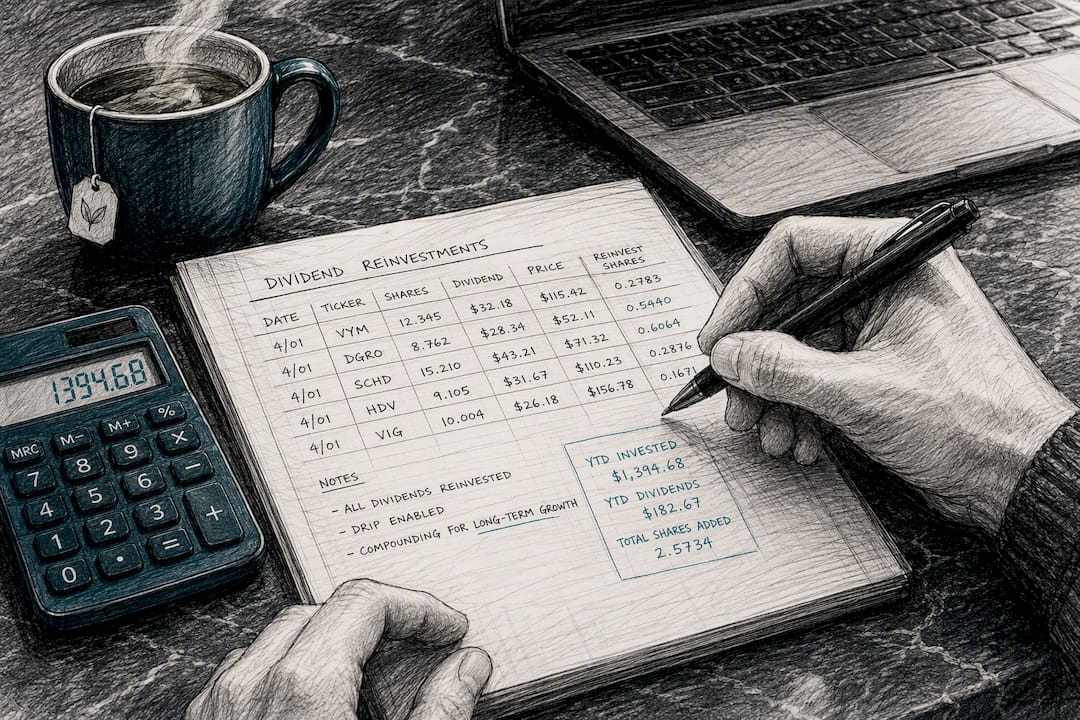
Say you hold shares that pay a dividend twice a year, and you've had that DRIP running for six years. You don't have one parcel of shares. You potentially have twelve or more, each with a different acquisition date and a different cost base equal to the dividend amount reinvested at the time.
Why this matters at disposal:
- Each DRIP parcel needs its own holding period calculated separately when you eventually sell, which affects whether a long-hold discount applies to that specific portion.
- The total cost base of your holding is the sum of every individual parcel's cost, not just your original lump-sum purchase.
- Selling only part of a DRIP-heavy holding requires you to identify exactly which parcels you're disposing of, since they won't all have the same tax outcome.
The practical fix is treating every reinvestment as a recordable event the moment it happens, not something to reconstruct years later from historical dividend statements. A spreadsheet tracking date, quantity, and reinvestment price per DRIP instalment turns what would otherwise be a forensic exercise at sale time into a straightforward lookup.
What happens to CGT when shares pass as a gift or inheritance
Giving shares away or receiving them through an estate doesn't necessarily avoid capital gains tax, it usually just shifts when and to whom the tax applies. Most jurisdictions treat a gift of shares as a disposal at market value on the date of the gift, even though no money changes hands. That means the giver can trigger a capital gain based on the market value at the time of transfer, not the price actually paid to them, because there wasn't one.
Inherited shares are typically treated differently again. Many systems allow the recipient to inherit the original cost base and acquisition date from the deceased, effectively carrying forward the tax history of the shares rather than resetting it. Other systems reset the cost base to market value at the date of death. Which approach applies depends entirely on local law, and the difference between the two can be significant if the shares have appreciated substantially over decades of holding.
Practical steps if you're receiving or giving shares this way:
- Confirm whether your jurisdiction treats the gift as a disposal event for the giver, and at what value.
- For inherited shares, obtain documentation of the deceased's original purchase price and date, since you may need this even years later.
- Keep probate or estate administration paperwork alongside your share records, as it may be the only proof of acquisition details available.
Given how much variation exists here, this is one of the areas where getting written confirmation of the applicable rule for your specific jurisdiction, rather than assuming a common convention applies, is worth the extra step.
What actually matters when you're calculating CGT on shares
Most guides on this topic focus heavily on rates and headline discount percentages, and not enough on the record-keeping discipline that determines whether you can even prove your numbers when it counts. A 50% discount means nothing if you can't substantiate your original cost base because a decade-old brokerage statement went missing.
The conventional advice to "keep good records" is true but useless without specifics. What actually protects you is treating every corporate action, every DRIP instalment, and every parcel as a discrete event worth logging the moment it happens, not reconstructing at tax time. Investors who model their disposal timing before selling, rather than after, consistently end up with better outcomes than those who calculate the damage retrospectively.
If there's one thing worth prioritising above the rest, it's this: understand your own jurisdiction's specific discount, indexation, or holding-period rule before you assume a common example applies to you. The mechanics in this guide are broadly consistent across systems. The numbers are not.
Frequently asked questions
Do I pay CGT every time I sell shares? You generally only pay CGT when your capital proceeds exceed your cost base, producing an actual gain. A sale at a loss creates a capital loss instead, which can offset other gains rather than generating a tax bill.
How is CGT calculated on shares in simple terms? Take what you received for the shares (capital proceeds), subtract what they cost you including brokerage (cost base), and that's your capital gain or loss before any discount, indexation, or loss offset is applied.
Are crypto gains and losses taxed the same way as shares? Many jurisdictions treat crypto assets under the same general capital gains framework as shares, meaning proceeds minus cost base still applies, though specific rules on what counts as a disposal event can differ. Confirm your own jurisdiction's treatment rather than assuming full parity with shares.
Does CGT apply to ETFs the same way it applies to individual shares? Yes, in most systems disposing of ETF units is treated as a CGT event in the same way as selling individual shares, using the same proceeds-minus-cost-base calculation and the same holding-period considerations for any available discount.
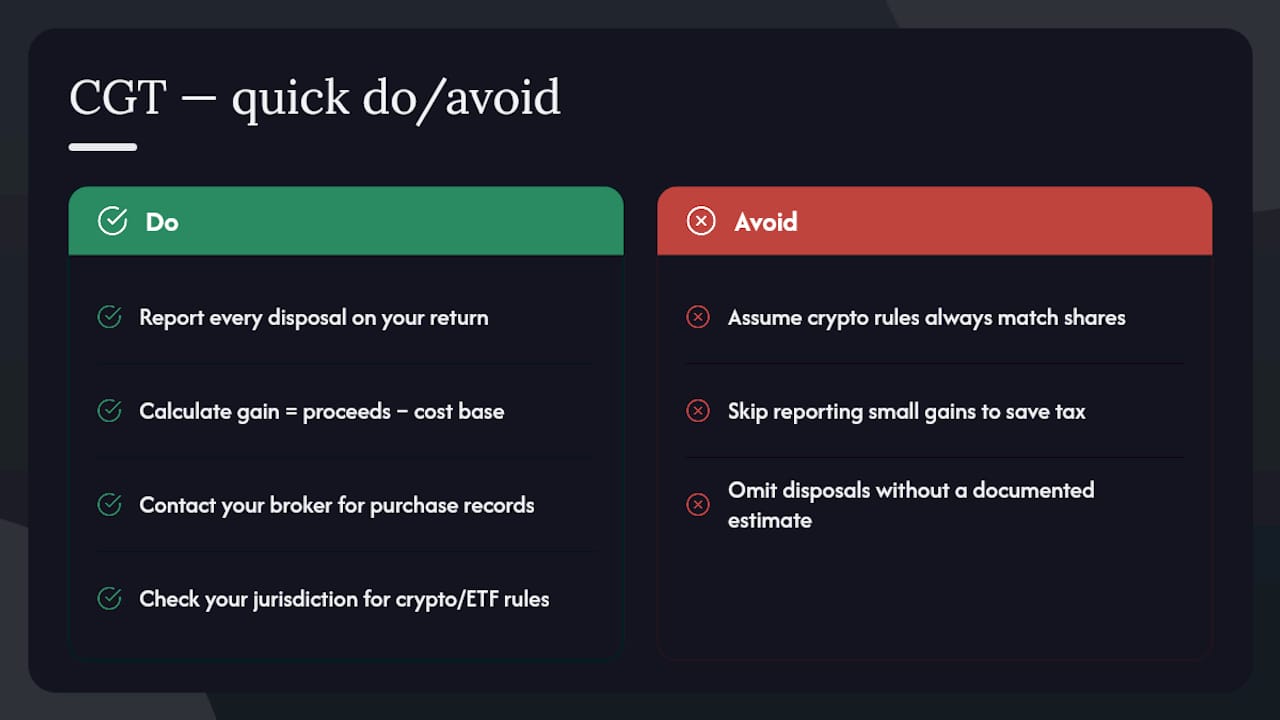
What if I can't find my original purchase records? Contact your broker or platform for historical statements, since most retain records for many years. Where records genuinely can't be recovered, tax authorities generally expect you to make a reasonable, documented estimate rather than omit the disposal from your return entirely.
Can I choose not to report a small capital gain? No. Most systems require every disposal to be reported regardless of size, even where the resulting tax owed is minimal or offset entirely by losses. Skipping small gains is a common but risky shortcut that can trigger discrepancies against data tax authorities already receive from brokers.
This article is general information, not a substitute for advice from a qualified financial advisor. Consult a qualified financial professional about your own circumstances before acting on anything here.
Sources
- How are capital gains taxed? — Tax Policy Center
- Personal investors guide to capital gains tax 2025
- The labyrinth of capital gains tax policy — Brookings