
TL;DR:
- Capital gains are profits from selling assets for more than their adjusted cost basis. The Australian Taxation Office taxes these gains as assessable income in the year of sale.
Capital gains are the profits you realise when you sell a capital asset for more than its adjusted cost basis. The Australian Taxation Office treats these profits as assessable income, meaning they directly affect your tax bill in the year you sell. For self-directed investors managing shares, property, or other investments, understanding how capital gains work is one of the most practical skills you can develop. Get it right and you keep more of what you earn.
What is capital gains and how is it defined?
A capital gain is the difference between what you paid for an asset and what you sold it for. The formal capital gains definition is: Capital Gain = Sale Price minus Adjusted Cost Basis. The adjusted cost basis is not simply the purchase price. It includes capital improvements and depreciation adjustments, which means your true cost base can shift significantly over time.
The distinction between realised and unrealised gains matters enormously for tax purposes. An unrealised gain exists on paper while you still hold the asset. Only a realised gain triggers a taxable event. Selling a parcel of BHP shares at a profit creates a realised gain. Watching those shares rise in value while you hold them does not.
Assets that commonly generate capital gains in Australia include shares listed on the ASX, investment property, managed funds, and collectibles. Your primary residence is generally exempt under Australian CGT rules, though conditions apply.
How is a capital gain calculated?
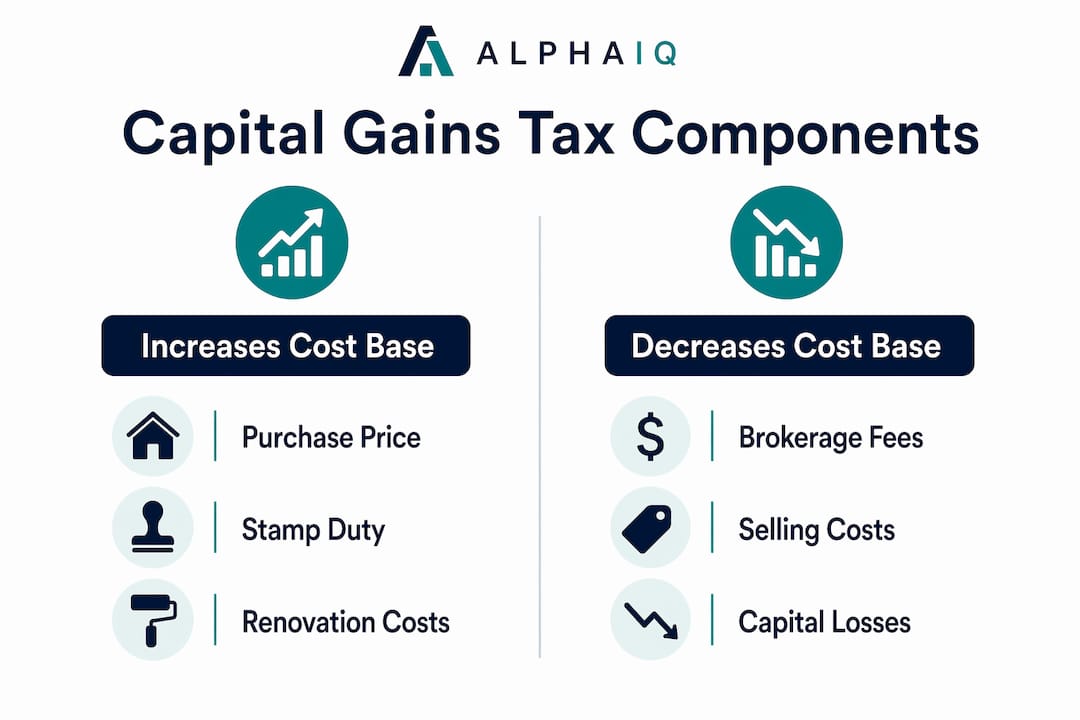
The calculation starts with your cost base. For a share purchase, the cost base includes the purchase price plus brokerage fees. For an investment property, it includes the purchase price, stamp duty, legal fees, and the cost of any capital improvements such as a renovation. Depreciation claimed on a rental property reduces the cost base, which increases the eventual gain.

| Component | Increases cost base | Decreases cost base |
|---|---|---|
| Purchase price | Yes | No |
| Stamp duty and legal fees | Yes | No |
| Capital improvements | Yes | No |
| Depreciation claimed | No | Yes |
| Selling costs (agent fees) | Yes | No |
Holding period determines whether a gain is classified as short-term or long-term. In Australia, assets held for more than 12 months qualify for the CGT discount. Assets sold within 12 months are taxed on the full gain at your marginal rate. This single distinction can halve your tax liability on the same profit.
Pro Tip: Keep a dedicated folder for every asset you own. Record the purchase contract, settlement statement, renovation invoices, and brokerage confirmations. Accurate cost base records are the single biggest factor in avoiding costly CGT errors.
What are the tax implications of capital gains in Australia?
Australian CGT rules apply to assets including property, shares, and collectibles. Capital gains are not taxed at a separate flat rate. Instead, the net capital gain is added to your assessable income and taxed at your marginal rate. For a taxpayer in the 37% bracket, a $50,000 gain adds $18,500 to their tax bill if no discount applies.
The CGT discount changes this picture significantly. Individuals who hold an asset for more than 12 months receive a 50% discount on the gross capital gain before it is added to their income. A $50,000 gain becomes a $25,000 assessable gain. That same 37% taxpayer now pays $9,250 rather than $18,500. The timing of asset sales can therefore substantially affect the tax you pay.
Key exemptions and concessions
- Primary residence exemption: Your main home is generally exempt from CGT, provided you have lived in it and have not used it to produce income.
- Small business CGT concessions: Eligible small business owners can access additional concessions including the 15-year exemption, the 50% active asset reduction, and the retirement exemption.
- Superannuation assets: Assets held inside a complying superannuation fund are taxed at a maximum rate of 15% on gains, and at 10% for assets held longer than 12 months within the fund.
- Step-up in basis at death: Inherited assets receive a step-up in cost base to market value at the date of death, eliminating the capital gains tax liability that accrued during the deceased's lifetime.
Pro Tip: If you are planning to sell an asset near the end of the financial year, consider whether delaying the sale past 30 june will push the gain into the next tax year. This can be useful if your income will be lower the following year.
Short-term vs long-term: a direct comparison
| Holding period | CGT discount | Tax treatment |
|---|---|---|
| Less than 12 months | None | Full gain taxed at marginal rate |
| More than 12 months (individual) | 50% | Half the gain taxed at marginal rate |
| More than 12 months (super fund) | 33.3% | Two-thirds of gain taxed at 15% |
How can investors manage and reduce capital gains tax?
Managing your CGT liability is not about avoiding tax. It is about making deliberate decisions that align your investment activity with the tax rules. These four approaches are the most effective for Australian self-directed investors.
-
Use capital losses to offset gains. Capital losses reduce your net capital gain in the same income year. If your losses exceed your gains, the excess carries forward indefinitely to offset future gains. Capital losses carry forward without expiry, making them a long-term planning asset in their own right.
-
Practise tax-loss harvesting. Tax-loss harvesting involves selling securities at a loss to offset gains elsewhere in your portfolio. Fidelity describes this as a method that actively manages your tax burden while supporting portfolio goals. The key discipline is avoiding the wash-sale trap: do not immediately repurchase the same or substantially identical asset.
-
Time your sales around the 12-month threshold. Waiting until an asset has been held for more than 12 months before selling qualifies you for the 50% CGT discount. This is one of the simplest and most powerful tax planning moves available to Australian investors. Review your tax-aware investing approach before selling any asset held close to the 12-month mark.
-
Track your cost base meticulously. Failing to record capital improvements, brokerage fees, or depreciation adjustments is one of the most expensive recordkeeping mistakes investors make. A higher cost base means a smaller gain and a lower tax bill.
Pro Tip: Review your portfolio in may and june each year. Identify assets sitting at a loss that you no longer want to hold. Selling them before 30 june locks in the loss for that tax year and reduces your assessable income.
What role does capital gains tax play in financial planning?
Capital gains tax is not just a tax event. It shapes investment behaviour at every stage of the wealth-building process. The realisation-based tax system creates what economists call the "lock-in effect": investors hold assets longer than they otherwise would because selling triggers a tax bill. This affects market liquidity and can lead to portfolios that are less diversified than they should be.
For long-term investors, CGT considerations influence several planning decisions:
- Asset location: Holding high-growth assets inside superannuation, where the tax rate on gains is capped at 15%, can significantly improve after-tax returns over a 20-year accumulation period.
- Portfolio rebalancing: Selling appreciated assets to rebalance triggers CGT. Some investors use new contributions or dividend reinvestment to rebalance without selling, avoiding the tax event entirely.
- Estate planning: The step-up in basis rule means that passing appreciated assets to heirs through an estate can eliminate decades of embedded capital gains. This makes asset transfer timing a genuine planning consideration.
- Retirement income sequencing: Drawing down on assets with a lower cost base first in retirement can preserve higher-basis assets for later, reducing the CGT impact across the retirement period.
Integrating tax planning into your investment strategy is not optional for serious investors. The difference between a tax-aware portfolio and a tax-blind one compounds significantly over time.
Key takeaways
Capital gains are taxable profits from selling assets above their adjusted cost base, and the 12-month holding period is the single most important factor in reducing your Australian CGT liability.
| Point | Details |
|---|---|
| Capital gains definition | A capital gain is the profit from selling an asset above its adjusted cost base. |
| 12-month CGT discount | Holding an asset more than 12 months halves the assessable gain for individual investors. |
| Capital losses carry forward | Unused capital losses carry forward indefinitely to offset future gains. |
| Cost base accuracy | Recording all purchase costs, improvements, and depreciation prevents costly tax errors. |
| Tax-loss harvesting | Selling assets at a loss to offset gains actively reduces your annual tax bill. |
The part most investors get wrong
Most investors focus on picking the right asset. Far fewer focus on what happens when they sell it. In my experience working with self-directed investors, the cost base is where the most money is left on the table. People forget to include stamp duty, legal fees, or the cost of renovations they completed years earlier. When the ATO assesses the gain, those omissions translate directly into a higher tax bill.
Tax-loss harvesting is another area where investors underperform. The concept is straightforward: sell a losing position to offset a winning one. But most people only think about it in the abstract. The ones who actually benefit are the ones who review their portfolio in may and june every year with a specific question in mind: which positions are sitting at a loss that I no longer believe in? That discipline, practised consistently, compounds into real savings.
The lock-in effect is real and worth acknowledging. I have seen investors hold assets they should have sold years ago simply because the CGT bill felt too large to trigger. The better question is whether the after-tax proceeds, reinvested into a better opportunity, would outperform the existing holding. Often they would. Tax should inform your decisions, not paralyse them.
For Australian investors in 2026, the interaction between CGT, superannuation, and estate planning is where the most sophisticated planning happens. Getting those three elements working together requires clear numbers, not guesswork.
— Jonathan
See your capital gains position clearly with Alphaiq
Understanding capital gains tax is one thing. Seeing exactly how it affects your wealth position is another. Alphaiq is built for Australian self-directed investors who want real numbers, not rough estimates.

The Alphaiq platform models your capital gains exposure across shares, property, and other assets, factoring in the CGT discount, cost base adjustments, and your marginal tax rate. You can run scenarios before you sell, not after. If you are also planning for retirement, the superannuation calculator shows how your super balance and CGT position interact over time. Use the CGT calculator to get a fast, accurate estimate of your liability under current 2025–26 rules.
FAQ
What is capital gains tax in Australia?
Capital gains tax in Australia is not a separate tax. It is the tax you pay on the net capital gain included in your assessable income, taxed at your marginal rate after applicable discounts and exemptions.
When does a capital gain become taxable?
A capital gain becomes taxable when you sell or dispose of an asset and realise a profit. Unrealised gains, where the asset has increased in value but you still hold it, are not taxable.
What is the CGT discount for Australian investors?
Individual Australian investors who hold an asset for more than 12 months receive a 50% discount on the gross capital gain. Superannuation funds receive a 33.3% discount on assets held for more than 12 months.
Can capital losses reduce my tax bill?
Yes. Capital losses offset capital gains in the same income year. If losses exceed gains, the surplus carries forward indefinitely and can be applied against future capital gains.
What assets are exempt from capital gains tax in Australia?
Your primary residence is generally exempt from CGT under Australian tax law, subject to conditions. Personal use assets below a certain threshold and some small business assets may also qualify for concessions or full exemptions.