
Tax-loss harvesting is the practice of selling investments at a loss to offset realised capital gains, reducing the amount of capital gains tax (CGT) you owe in a given financial year. It is a legitimate, widely used strategy among self-directed investors in Australia, and when executed correctly, it can meaningfully improve your after-tax returns without requiring you to exit the market entirely.
Table of Contents
- What is tax loss harvesting and how does it work in Australia?
- Why tax-loss harvesting benefits your investment portfolio
- How to execute tax-loss harvesting step by step
- Australian tax rules you must understand before harvesting losses
- A practical Australian example of tax-loss harvesting
- Limitations and risks you should weigh carefully
- Key takeaways
What is tax loss harvesting and how does it work in Australia?
At its core, tax-loss harvesting means deliberately crystallising a capital loss on an underperforming investment so you can use that loss to reduce a capital gain you have already realised, or expect to realise, in the same financial year. The Australian Taxation Office (ATO) governs how capital losses are applied, and the rules are specific.
Key mechanics to understand:
- You must sell the investment to realise the loss. A paper loss on a holding you still own cannot be claimed.
- Capital losses offset capital gains only, not salary, rental income, or any other ordinary income.
- Unused capital losses carry forward indefinitely and can offset future capital gains in later years.
- The strategy applies to CGT assets: ASX-listed shares, exchange-traded funds (ETFs), managed funds, and property.
- The ATO, not a mechanical rule, determines whether a transaction is genuine or an artificial tax scheme.
This last point is where Australian tax-loss harvesting diverges sharply from the US approach, and it is the detail most investors overlook.
Why tax-loss harvesting benefits your investment portfolio
Done well, the strategy delivers several compounding advantages beyond a single year's tax saving.
- Reduce or eliminate CGT for the year. Matching losses against gains can bring your net taxable capital gain to zero, deferring or eliminating the tax bill entirely.
- Carry losses forward. If your losses exceed your gains in a given year, the surplus carries forward indefinitely. Those banked losses become a future tax asset.
- Improve portfolio tax efficiency. Systematically harvesting losses as part of your annual review keeps your tax-aware investing discipline sharp and reduces the drag of CGT on compounding returns.
- Support portfolio rebalancing. Selling an underperformer to harvest a loss naturally creates an opportunity to rebalance your allocation, replacing the sold asset with one that better fits your current strategy.
- Improve cash flow. Reducing your CGT liability means more capital stays invested rather than flowing to the ATO.
- Compound effect over time. Tax deferred is tax that continues working in your portfolio. Over a decade, the compounding benefit of deferring CGT each year can be substantial, particularly for investors in higher marginal tax brackets.
The strategy is most powerful when it is integrated into your broader capital gains tax strategy rather than treated as a once-a-year scramble before 30 June.
How to execute tax-loss harvesting step by step
The process is straightforward, but the details matter, particularly around timing and compliance.
Step 1: Identify candidates
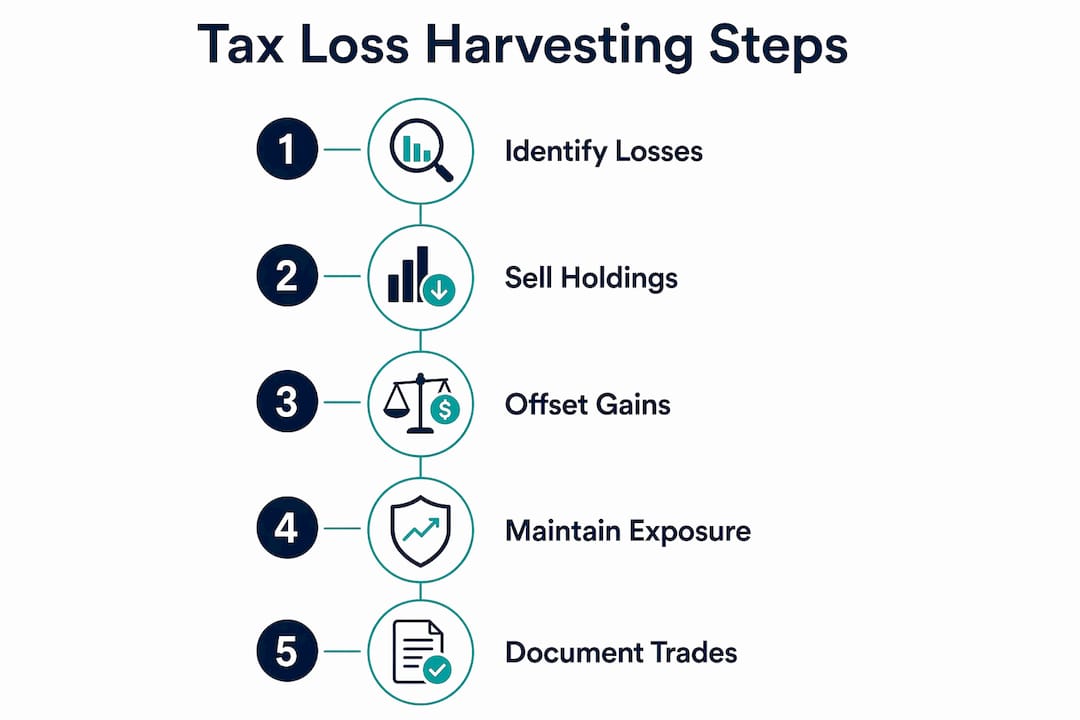
Review your portfolio for holdings trading below their cost base. Your cost base includes the original purchase price plus brokerage and other acquisition costs.

Step 2: Sell to realise the loss
Place the sell order before 30 June. On ASX securities, the trade date determines the CGT event, not the settlement date. Because ASX operates on T+2 settlement, a trade executed on 28 June settles on 30 June, but a trade on 29 June settles on 1 July. The CGT event still falls in the current financial year regardless of when settlement occurs, but to avoid any administrative uncertainty, executing trades by 27 or 28 June is prudent.
Step 3: Offset gains
Apply the realised loss against any capital gains you have already crystallised during the year. The ATO requires losses to be applied before the 50% CGT discount is calculated on net gains.
Step 4: Maintain market exposure (carefully)
To stay invested in the sector or theme, you can purchase a different but correlated security. For example, if you sell a position in one ASX-listed resources ETF at a loss, you might replace it with a different resources ETF from a different provider. The key word is different. Buying back the same or substantially identical security immediately after selling triggers ATO scrutiny under Part IVA.
Step 5: Document everything
Record the commercial rationale for each sale, whether that is rebalancing, adjusting sector exposure, or exiting a position you no longer believe in. This documentation is your first line of defence in an audit.
| Step | Action | Timing |
|---|---|---|
| Identify loss candidates | Compare current price to cost base | Ongoing, review before May |
| Execute sell orders | Sell on ASX to realise capital loss | By late June for EOFY |
| Apply losses to gains | Net losses against realised gains | At tax return preparation |
| Replace with different asset | Buy correlated but non-identical security | After sale, no fixed waiting period |
| Document rationale | Record commercial purpose in writing | At time of transaction |
Pro Tip: Set a calendar reminder in April each year to review unrealised losses. Waiting until late June compresses your decision-making and increases the risk of rushed, poorly documented trades.
Australian tax rules you must understand before harvesting losses
Australia does not have a formal "wash sale" rule with a fixed timeframe, as the United States does with its 30-day restriction. Instead, the ATO applies Part IVA of the Income Tax Assessment Act 1936, a general anti-avoidance provision that targets schemes whose dominant purpose is obtaining a tax benefit.
What this means in practice:
- No safe harbour period. Unlike the US 30-day rule, waiting 31 days does not automatically protect you. The ATO assesses the dominant purpose of the transaction regardless of timing.
- Substance over form. If you sell a holding and immediately repurchase the same or substantially identical asset, the ATO may treat the transaction as having no genuine change in economic exposure, and deny the capital loss entirely.
- Consequences are serious. The ATO can cancel the tax benefit, impose additional tax, charge interest, and apply penalties.
- Genuine commercial purpose is your protection. Selling an underperformer because you want to rebalance, reduce concentration risk, or shift to a better-positioned asset is a legitimate commercial reason. Selling purely to generate a loss with the intention of buying back the same position is not.
- Replacing with a different security reduces risk. Buying a different but correlated asset after a sale signals commercial intent and reduces Part IVA exposure.
- Capital losses offset capital gains only, and unused losses carry forward indefinitely under Australian tax law.
- CGT discount order matters. The 50% CGT discount for assets held more than 12 months applies after capital losses have been netted against gains, not before.
- Record keeping is not optional. Documenting your commercial reasons for each sale, including notes on portfolio rationale and changes in exposure, is what defends you if the ATO asks questions.
Pro Tip: Never structure a trade as a sell-and-immediate-repurchase of the same security. Even if you wait a few weeks, the ATO can still apply Part IVA if the evidence suggests your dominant purpose was the tax benefit rather than a genuine investment decision.
A practical Australian example of tax-loss harvesting
Consider an investor, Sarah, who holds a diversified ASX portfolio and has realised a $20,000 capital gain earlier in the financial year from selling shares held for more than 12 months.
| Security | Purchase Price | Current Value | Unrealised Gain / Loss |
|---|---|---|---|
| ASX: XYZ (sold for gain earlier) | — | — | +$20,000 gain |
| ASX: ABC (held, underperforming) | — | — | -$10,000 loss |
| ETF: DEF (held, underperforming) | $18,000 | $10,000 | — |
Sarah sells both ABC and DEF before 28 June, realising a total capital loss of $18,000.
- Gross capital gain reduced by realised capital losses, resulting in a substantially lower taxable capital gain after applying the 50% CGT discount on net gains
Without harvesting, Sarah's taxable capital gain would have been $10,000 after the 50% discount. By crystallising $18,000 in losses, she reduces her taxable gain to $1,000, a significant tax saving depending on her marginal rate.
After selling ABC and DEF, Sarah purchases two different ETFs with similar but not identical sector exposure, maintaining her portfolio's market position without triggering Part IVA concerns. She records in writing that the sales were driven by a decision to exit underperforming positions and rebalance toward better-positioned funds. The trade date for all sales falls before 30 June, confirming the CGT events occur in the current financial year.
Key compliance points Sarah follows:
- Sells different securities than she repurchases
- Documents her commercial rationale at the time of the trade
- Does not repurchase ABC or DEF within a short period
- Applies losses against gains before calculating the CGT discount
Limitations and risks you should weigh carefully
Tax-loss harvesting is not a free lunch, and several real constraints apply.
The ATO's subjective test creates uncertainty. Because Part IVA relies on dominant purpose rather than a mechanical rule, there is no guaranteed safe outcome. Even a well-intentioned trade can attract scrutiny if the documentation is thin or the repurchase looks opportunistic.
You can only offset capital gains, not income. If you have no capital gains in a year, harvested losses simply carry forward. They do not reduce your salary or other assessable income, so the benefit is deferred rather than immediate.
Transaction costs reduce the net benefit. Brokerage on the sell and the replacement buy eats into the tax saving. For smaller portfolios or modest losses, the cost-benefit calculation may not stack up.
Replacing assets changes your portfolio. Buying a correlated but different security means your portfolio no longer holds exactly what you intended. If the sold asset subsequently recovers strongly, you miss that gain.
The CGT discount interaction can reduce the benefit. Because losses are applied before the 50% discount, a $10,000 loss offsets $10,000 of gross gain, but that gross gain would only have been taxed on $5,000 after the discount. The effective tax saving is on the discounted amount, not the full loss.
Poor record keeping is a genuine risk. The ATO's subjective approach means your records are your defence. Investors who cannot demonstrate a commercial rationale for their trades are exposed.
Tax-loss harvesting works best as part of a considered portfolio rebalancing discipline, not as a reactive end-of-year scramble. Used thoughtfully, it is one of the more reliable tools available to self-directed investors for improving after-tax returns within the Australian tax system.
Key takeaways
Tax-loss harvesting reduces your CGT liability by offsetting realised capital gains with realised losses, but compliance with ATO anti-avoidance rules under Part IVA is non-negotiable for the strategy to hold up.
| Point | Details |
|---|---|
| Capital losses offset gains only | Losses cannot reduce salary or other income; unused losses carry forward indefinitely. |
| Trade date governs CGT timing | On ASX securities, the trade date determines the financial year, not the settlement date. |
| No fixed safe harbour period | Australia's Part IVA tests dominant purpose, not a set number of days between sale and repurchase. |
| Replace with a different asset | Buying a correlated but non-identical security maintains exposure and reduces Part IVA risk. |
| Document commercial rationale | Written records of your investment reasons are your primary defence in an ATO audit. |

Alphaiq is built for self-directed Australian investors who want to model exactly this kind of tax-aware decision before they act. The platform lets you run CGT scenarios, stress-test your portfolio rebalancing, and see the after-tax impact of harvesting losses across your investments, superannuation, and property, all without the cost of ongoing advice. Explore Alphaiq to see how tax-aware modelling can work for your portfolio.