
TL;DR:
- Proactive bonus tax planning involves actions before and after payment to reduce tax while remaining compliant. Key strategies include maximizing super contributions, timing bonuses across financial years, and bundling deductions before June 30. Acting early helps Australians manage their tax liability and optimize their financial position effectively.
A bonus tax planning checklist is a targeted series of proactive steps designed to reduce the tax you pay on bonus income, so you keep more of what you earn while staying fully compliant with Australian Tax Office (ATO) requirements. For Australians aged 35–65, a bonus can push you into a higher marginal tax bracket without warning, making pre-emptive planning the difference between a windfall and a tax bill. The strategies in this guide cover everything from superannuation contributions and salary sacrifice to charitable giving and PAYG withholding adjustments. Working through each step before and after your bonus is paid gives you the clearest path to a better tax outcome.
1. How is your bonus income taxed in Australia?
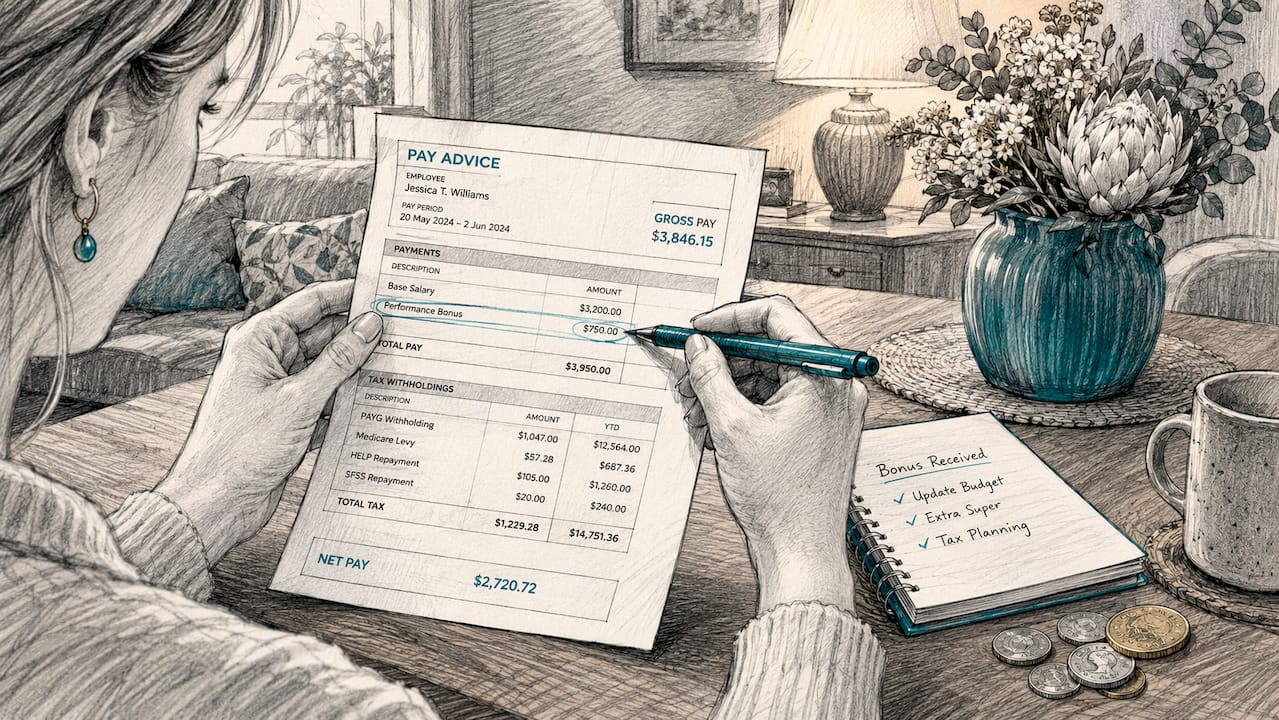
Your employer withholds tax on your bonus using one of two payroll methods. The first is the flat rate method, where a single withholding rate applies to the bonus amount. The second is the aggregate method, where your employer combines the bonus with regular pay, calculates tax on the combined figure, then subtracts what was already withheld. Both methods produce different numbers on your pay stub, but your final tax liability is always based on your total annual income.
This distinction matters because withholding is a prepayment, not your final tax. If your marginal rate is higher than what was withheld, you will owe the difference at tax time. For many Australians in the 37% or 45% marginal bracket, withholding often falls short of the actual liability, creating an unexpected bill in july.
Superannuation guarantee contributions also apply to bonuses in most cases, though the rules depend on how your bonus is classified under your employment contract. Check with your payroll team whether your bonus is treated as ordinary time earnings, as this affects the super rate applied.
Pro Tip: Review your pay stub the moment your bonus is processed. Confirm the withholding method used and compare it against your estimated marginal rate for the year. If there is a gap, act before 30 june.
2. Pre-bonus actions: your bonus tax planning checklist
Acting before your bonus hits your account gives you the most control. These steps form the core of any effective year-end tax checklist.
-
Maximise your concessional super contributions. The concessional contribution cap for 2025–26 is $30,000. Salary sacrifice arrangements let you direct pre-tax dollars into super, reducing your assessable income before your bonus is added. Review your super contribution strategy well before your employer processes the payment.
-
Check your carry-forward contribution entitlement. If your total super balance was below $500,000 on 30 june of the prior year, you can use unused concessional cap amounts from the previous five years. This is one of the most underused tools for high earners receiving a large bonus.
-
Confirm your salary sacrifice arrangement covers the bonus. Many employers run separate payroll processes for bonuses. Deferral elections must be finalised before the payroll cut-off, which is often earlier than you expect. Contact your HR or payroll team at least two weeks before the expected payment date.
-
Assess your private health insurance offset. Australians without hospital cover earning above the Medicare Levy Surcharge threshold pay an additional 1%–1.5% levy. A bonus that pushes you over the threshold mid-year makes it worth reviewing your cover before payment.
-
Consider timing your bonus across financial years. If you expect lower income next year, ask your employer whether deferring the bonus to the new financial year is possible. Not all employers allow this, but it is worth the conversation.
-
Review your PAYG withholding variation. You can lodge a PAYG withholding variation with the ATO to adjust the amount withheld from your pay. This is particularly useful if you have significant deductions planned for the year.
Pro Tip: Payroll cut-off dates for bonus deferral elections often fall weeks before the actual payment. Missing this window means planning windows close and your options narrow significantly. Put a calendar reminder for at least three weeks before your expected bonus date.
3. Post-bonus strategies to reduce your tax bill
Once your bonus is paid, you still have meaningful options. The key is acting before 30 june.
-
Make a personal deductible super contribution. You can contribute after-tax money to super and claim a tax deduction, provided you lodge a notice of intent to claim with your fund before filing your return. This converts taxable income into concessionally taxed super at 15%, which is a significant saving if your marginal rate is 37% or 45%.
-
Bundle charitable donations. Strategic charitable giving in a high-income year produces a larger deduction than spreading donations across multiple years. Donate to Deductible Gift Recipients (DGRs) registered with the ATO before 30 june to claim the deduction in the current year.
-
Harvest capital losses. If you hold investments sitting at a loss, selling before 30 june crystallises those losses and offsets capital gains from other assets. This is particularly relevant if your bonus year coincides with a strong investment return.
-
Prepay deductible expenses. Investment loan interest, income protection insurance premiums, and certain professional subscriptions can be prepaid up to 12 months in advance and claimed in the current year. This pulls forward deductions to offset your bonus income.
-
Review your PAYG instalment rate. If your bonus has increased your income significantly, your current instalment rate may leave you underpaid. Adjust your instalment amount to avoid a penalty at tax time.
-
Keep meticulous records. The ATO requires substantiation for most deductions. Receipts, bank statements, and contribution notices should be filed digitally as soon as the transaction occurs.
4. Comparing bonus tax planning methods
Different approaches suit different financial profiles. The table below outlines the main strategies, their primary benefit, and who they suit best.
| Strategy | Primary tax benefit | Best suited to |
|---|---|---|
| Salary sacrifice to super | Reduces assessable income before bonus is taxed | Employees with employer flexibility on bonus payroll |
| Personal deductible super contribution | Converts after-tax income to 15% taxed super | Anyone under 75 with unused cap space |
| Carry-forward concessional contributions | Uses prior-year unused cap to absorb large bonus | Those with super balance under $500,000 |
| Charitable donation bunching | Increases deduction in high-income year | Donors who give regularly and can consolidate timing |
| Capital loss harvesting | Offsets capital gains to reduce net taxable income | Investors with unrealised losses in their portfolio |
| PAYG withholding variation | Aligns withholding to actual liability | Self-managed earners with predictable deductions |
No single method works for every situation. A combination of two or three strategies, applied in sequence, typically produces the best outcome.
5. Situational recommendations for different financial profiles
Your bonus tax strategy should reflect your specific circumstances. Generic advice rarely captures the full picture.
-
High-income earners above $180,000. Your marginal rate is 45% plus the Medicare Levy. The gap between withholding and actual liability can be substantial. Prioritise carry-forward super contributions and capital loss harvesting. Also check whether the Division 293 tax applies to your super contributions, as it adds an extra 15% tax on concessional contributions for high earners.
-
Australians aged 50–65 approaching retirement. The retirement tax strategies available to you are significant. You can use the catch-up concessional contribution rules aggressively if your balance allows. Directing bonus income into super now reduces your taxable estate and builds a tax-free retirement pool.
-
Investors with capital gains. If you sold property or shares at a gain this year, your bonus compounds the tax impact. Prioritise loss harvesting and deductible super contributions to bring your net taxable income down before 30 june.
-
Those with multiple income streams. Freelance income, rental income, and a salary bonus can interact in ways that push you into a higher bracket than expected. Tax planning for investors with complex income profiles requires a consolidated view of all sources before deciding which strategy to apply first.
-
Commonly missed opportunity: the low-income super tax offset (LISTO). If your income including the bonus stays below $37,000, the ATO automatically credits up to $500 to your super account. This is worth confirming with your fund if your income fluctuates year to year.
-
Tax planning is a multi-year exercise. Actions taken after 30 june shift benefits into the next financial year and require a separate strategy. Reviewing your position in april or may each year, rather than in june, gives you the most options.
Key takeaways
Effective bonus tax planning requires acting before your bonus is paid, not after, with super contributions and salary sacrifice as the highest-impact tools available to Australian employees.
| Point | Details |
|---|---|
| Act before payroll cut-off | Salary sacrifice and deferral elections must be lodged before your employer processes the bonus. |
| Use carry-forward super contributions | Australians with super balances under $500,000 can use up to five years of unused concessional cap. |
| Bundle deductions in high-income years | Charitable donations and prepaid expenses are most valuable when your marginal rate is at its peak. |
| Withholding is not your final tax | The amount withheld from your bonus is a prepayment only; your actual liability depends on total annual income. |
| Review your position annually in May | Waiting until june limits your options; a May review gives you time to act on every available strategy. |
What I've learned from watching Australians get their bonus tax wrong
The most common mistake I see is treating a bonus as a separate event rather than part of a full-year income picture. Someone receives $30,000 in november, spends it, and then faces a $9,000 tax bill the following july. The money is gone and the options are limited.
The second mistake is assuming the withholding on the pay stub is accurate. Employers combine bonuses with regular pay using the aggregate method, which can make withholding look higher than it is, or lower, depending on the timing. Neither figure tells you what you actually owe.
What works is treating your bonus date as a planning trigger, not a payday. The moment you know a bonus is coming, you should be reviewing your super cap space, your deductible expenses, and your PAYG position. That review takes an hour. The tax saving can be thousands of dollars.
The carry-forward concessional contribution rule is the most underused tool in this space. Australians with super balances under $500,000 can contribute significantly more than the standard $30,000 cap in a single year, absorbing a large bonus at 15% tax rather than 37% or 45%. Most people have never heard of it.
My honest view is that a structured checklist, reviewed every year in april or may, is worth more than any single strategy. Bonus season is an opportunity for deliberate financial planning. Treat it that way and the compounding benefit over a decade is material.
— Jonathan
How Alphaiq supports your bonus tax planning
Alphaiq is built for Australians who want to model their financial position with real numbers, not guesswork. The platform lets you run scenario simulations across super contributions, capital gains, and income projections, so you can see exactly how a bonus affects your tax position before you decide how to act.

The Alphaiq super calculator projects your retirement balance under different contribution scenarios, including the impact of directing bonus income into super via salary sacrifice or personal deductible contributions. You can test carry-forward contribution strategies and see the long-term compounding effect in minutes. For Australians aged 35–65 managing complex income, the Alphaiq wealth platform gives you a consolidated view of your financial position without the cost of ongoing advice.
FAQ
What tax rate applies to bonuses in Australia?
Bonuses are taxed at your marginal income tax rate, not a separate flat rate. Your employer withholds tax using either the flat rate or aggregate method, but your final liability is calculated on your total annual income when you lodge your return.
Can I put my bonus directly into superannuation?
Yes. You can salary sacrifice your bonus into super before it is paid, or make a personal after-tax contribution and claim a deduction. Both approaches reduce your assessable income, though salary sacrifice must be arranged before your employer processes the payment.
What is the concessional contribution cap for 2025–26?
The concessional contribution cap is $30,000 for the 2025–26 financial year. If your total super balance was below $500,000 on 30 june 2025, you may also be able to use unused cap amounts from the previous five years under the carry-forward rules.
What happens if my bonus pushes me into a higher tax bracket?
Your bonus is added to your other income for the year and taxed at the applicable marginal rate on the total. Only the portion of income that exceeds each threshold is taxed at the higher rate. Pre-bonus strategies like super contributions reduce your total assessable income before the bracket calculation applies.
When is the deadline for post-bonus tax strategies?
Most strategies, including personal deductible super contributions, charitable donations, and capital loss harvesting, must be completed by 30 june to count in the current financial year. Year-end planning windows close at midnight on 30 june, with no extensions available.