
After-tax return is the profit you actually keep from an investment once all applicable taxes have been paid. It is the truest measure of investment performance, because it reflects what ends up in your pocket rather than what appears on a fund manager's marketing sheet. For Australian investors, the gap between a headline return and the after-tax equivalent can be striking, shaped by your marginal tax rate, capital gains tax (CGT), the Medicare levy, and the dividend imputation system with its franking credits.
Three taxes most commonly reduce your investment return in Australia:
- Marginal income tax rate, applied to dividends, interest, and distributions
- Capital gains tax, applied when you sell an asset at a profit
- Medicare levy, currently 2%, added on top of your marginal rate
Understanding your after-tax investment return is not just an accounting exercise. It is the foundation of every sound investment and tax planning decision you make.
Table of Contents
- How does pre-tax return differ from after-tax return, and why does it matter?
- Key Australian tax concepts that shape your after-tax returns
- How to calculate after-tax return on your investments
- What after-tax return means for your investment decisions
- Research insights: tax drag, tax alpha, and the compounding cost of getting this wrong
- Key takeaways
How does pre-tax return differ from after-tax return, and why does it matter?
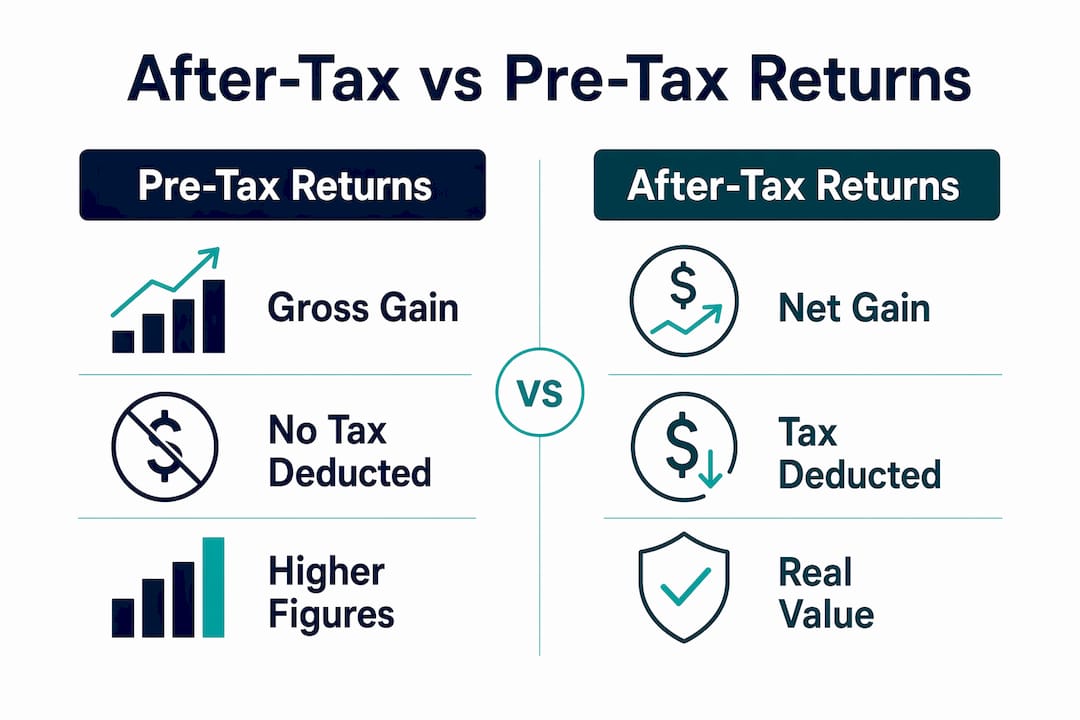
Pre-tax return is the gross gain on an investment before any tax is deducted. It is the figure most prominently displayed in fund performance tables, product disclosure statements, and financial media. After-tax return is what remains once the Australian Taxation Office (ATO) has taken its share.
The practical difference can be significant. Consider a managed fund reporting a 10% annual return. For an investor on the top marginal rate of 45% plus the 2% Medicare levy, the after-tax return on that same 10% drops to just 5.3%. An SMSF in pension mode, by contrast, pays no tax and retains the full 10%.
Relying on pre-tax figures alone creates a distorted picture of performance. Two investors holding the same fund can experience materially different outcomes purely because of their tax positions. Franking credits add another layer: a fully franked dividend carries a tax credit for corporate tax already paid, which can reduce your personal tax bill or even generate a cash refund if your tax rate is lower than the corporate rate. Ignoring these credits when comparing investments means you are not comparing like with like.
Key Australian tax concepts that shape your after-tax returns
Several tax rules interact to determine how much of your investment gain you retain. Understanding each one helps you make better decisions about what to hold and how long to hold it.
Marginal tax rates and the Medicare levy

Australia uses a progressive income tax system. Your investment income, including dividends, interest, and trust distributions, is taxed at your marginal rate, which ranges from 0% for income below $18,200 to 45% for income above $190,000. Add the 2% Medicare levy and the top effective rate reaches 47%.
Capital gains tax and the 50% discount
CGT applies when you sell an asset for more than you paid for it. The net capital gain is added to your assessable income and taxed at your marginal rate. Crucially, assets held over 12 months qualify for a 50% CGT discount for individuals and trusts, halving the taxable portion of the gain. This single rule rewards patience and is one of the most powerful levers available to Australian investors.
Dividend imputation and franking credits
Australia's dividend imputation system allows companies to pass on a credit for the 30% corporate tax already paid on profits. When you receive a franked dividend, you gross it up by the franking credit and include the total in your assessable income, then offset the credit against your tax liability. For investors in lower tax brackets, or SMSFs in pension phase, excess franking credits are refunded in cash, meaning your after-tax yield can exceed the headline dividend rate.
How to calculate after-tax return on your investments
The basic formula is straightforward:
After-tax return = Pre-tax return × (1 − effective tax rate)
For income such as dividends and interest, your effective tax rate is your marginal rate plus the Medicare levy. For capital gains on assets held over 12 months, you apply the 50% discount first, then tax the remaining half at your marginal rate.
Example: franked dividend
Suppose you receive a $700 cash dividend that is fully franked at the 30% corporate rate. The franking credit is $300, making the grossed-up dividend $1,000. If your marginal rate is 32% (plus 2% Medicare levy = 34%), your tax on $1,000 is $340. After subtracting the $300 franking credit, you owe just $40 in additional tax. Your net receipt is $700 minus $40, or $660. On a $10,000 investment, that is a 6.6% after-tax yield versus a 7% headline yield, a meaningful but manageable difference.
Example: capital gain with the 50% discount
You sell shares for a $10,000 gain after holding them for 18 months. The 50% discount reduces the taxable gain to $5,000. At a 34% effective rate, you pay $1,700 in CGT, leaving you with an $8,300 net gain. Without the discount, you would have paid $3,400 in tax.
One important distinction: pre-liquidation calculations include unrealised gains, while post-liquidation calculations account only for gains realised at sale. The post-liquidation figure is the more conservative and accurate measure of your true after-tax position.
Pro Tip: Many investors confuse gross dividend yields with actual net yields because they overlook franking credit adjustments. Use Alphaiq's franking credit calculator to see your true after-tax yield before comparing investment options.
What after-tax return means for your investment decisions
After-tax return should sit at the centre of how you evaluate and structure your portfolio, not as an afterthought at tax time. Two investments with identical pre-tax returns can produce very different outcomes depending on how their income is classified and where the asset is held.
Tax-efficient structures make a real difference:
- Superannuation taxes earnings at 15% in accumulation phase and 0% in pension phase, making it the most tax-favoured environment for long-term growth assets
- Holding periods of more than 12 months unlock the 50% CGT discount, which effectively halves your tax on capital growth
- Asset location, placing income-generating assets in low-tax structures and growth assets where the CGT discount applies, can add 1–2% per year to after-tax returns without changing the underlying investments at all
The danger of ignoring tax is not just a lower return in any single year. It is the compounding effect over decades. Deferring a capital gain by 12 months to access the CGT discount, or holding a high-yield asset inside super rather than in your personal name, are decisions that cost nothing in additional risk but can compound meaningfully over time.
MoneySmart rightly notes that tax considerations should not override your financial goals or risk tolerance. The goal is tax-aware investing, not tax-driven investing.
Pro Tip: Track your after-tax returns separately from your headline returns. If your platform only shows pre-tax performance, you are measuring the wrong number. Alphaiq's tax-aware modelling tools let you see both figures side by side.
Research insights: tax drag, tax alpha, and the compounding cost of getting this wrong
Tax drag is the reduction in your net return caused by taxes on investment income and gains. Its impact grows in lower-return environments. If your portfolio earns 10% and loses 2% to tax, the drag is 20% of your return. If it earns 6% and still loses 2% to tax, the drag is 33% of your return. The tax bill does not shrink just because markets do.
Tax alpha is the additional return you generate purely through tax-efficient structuring, with no extra risk and no market timing. It includes strategies like deferring capital gains, placing assets in the right structure, and making full use of franking credits. As Morningstar notes, tax alpha is becoming more valuable as market returns moderate, because the relative cost of tax drag rises when gross returns are lower.
The compounding effect of even a small after-tax return difference is striking. Over a multi-decade period, a modest net annual return gap can lead to a substantial difference in final portfolio value when identical gross returns and contributions are assumed.
Many investors fail to measure after-tax returns accurately because their platforms do not support it. This gap in measurement leads to genuine misconceptions about portfolio growth. The FTSE ASFA Australia Index Series, launched in 2009, established the first industry-standard after-tax benchmark for superannuation funds precisely because after-tax performance cannot be managed without being measured.
Key takeaways
After-tax return is the only measure that tells you what your investments are genuinely worth to you, and in Australia, the gap between pre-tax and after-tax outcomes is shaped by marginal rates, CGT discounts, and the franking credit system working together.
| Point | Details |
|---|---|
| After-tax return is the true measure | It shows what you keep after tax, not just what the investment earned before the ATO's share. |
| Tax varies sharply by investor type | A 10% gross return yields 10.0% for an SMSF in pension mode but only 5.3% at the top marginal rate, reflecting the sharp impact tax rate differences have on after-tax investment outcomes. |
| The 50% CGT discount rewards patience | Holding assets for more than 12 months halves the taxable portion of your capital gain. |
| Asset location adds 1–2% annually | Placing assets in the right structure improves after-tax returns without changing the underlying investment. |
| Compounding amplifies tax differences | A 2.2% net return gap over 30 years can produce a final value difference exceeding $779,000. |