Your main residence is generally exempt from capital gains tax if you're an Australian resident who has lived in the property for the whole time you owned it, never used it to earn income and sits on two hectares of land or less. Miss any of those conditions and you're likely looking at a partial exemption, not a full one. Two dates matter more than you'd think: the contract date (not settlement) sets your CGT event, and if you've ever rented the place out, the six-year rule decides how much of that period still counts as exempt.
TL;DR:
- Full exemption requires the property to be continuously occupied by the owner and never used for income production, with land size limited to two hectares or less.
- Partial exemption applies if any part of the property or ownership period was used for rental or business, requiring proportional apportionment based on floor area and time used.
- The six-year rule allows owners to rent out their former main residence and still claim full exemption for up to six years after moving out, but it resets with each new absence.
- The contract date, not settlement, triggers the capital gains tax event, and accurate record-keeping of occupation and rental periods is vital for substantiation.
- AlphaIQ’s CGT modelling tool helps evaluate different scenarios and timing options, but accurate timeline details and adherence to the rules are essential before selling.
Table of Contents
- What qualifies for a full main residence exemption
- When the exemption is partial: renting, business use or subdividing
- The 6-year rule: treating a rented former home as your main residence
- Working out your taxable gain and when to report it
- Common scenarios and a pre-sale checklist
- How AlphaIQ models CGT outcomes and why that helps
- Where to check the official rules and useful tools
- The eligibility-first approach beats the tax-time scramble
- Sources
What qualifies for a full main residence exemption
The Australian Taxation Office doesn't hand out the main residence exemption just because you call a property "home". It looks at how you've actually used the place. Practical indicators the ATO and courts have relied on include where your personal belongings are kept, the address on your mail and driver's licence, your electoral roll enrolment, and whether utilities are connected in your name.
To claim the full exemption, your property generally needs to tick every one of these boxes:
- You and your family have lived in the dwelling for the entire period you've owned it.
- The property has never been used to produce assessable income, meaning no rental income, no home-based business claiming a tax deduction, and no structured Airbnb operation.
- You haven't acquired and disposed of it as part of a profit-making scheme (the ATO takes a dim view of rapid "renovate and flip" cycles dressed up as a main residence).
- The land the dwelling sits on is two hectares or less. Anything beyond that, and the excess land typically falls outside the exemption.
A few situations complicate an otherwise straightforward claim. If you built a new home, you generally get some years from settlement of the land to complete construction and move in, and that period can still count as exempt. Inherited properties carry their own separate rules under the deceased estate provisions, often allowing a full exemption if sold within a specified period after the death. And if your home was destroyed by fire, natural disaster or demolition, you can usually still claim the exemption on the land while you rebuild, provided you move back in once construction finishes.
None of this matters if you can't back it up later. Keep settlement statements, rates notices, insurance documents, and anything showing continuous occupation, because the ATO can ask you to substantiate a main residence claim years after you've sold. A folder of utility bills sitting in a drawer for a decade is dull. It's also the difference between a clean exemption and a drawn out amendment request.
When the exemption is partial: renting, business use or subdividing
A full exemption assumes total, exclusive use as your home. The moment part of the property, or part of the time you owned it, was used to produce income, the ATO applies apportionment rather than an all-or-nothing test. Using your home for rental or business means that portion loses its exempt status, and CGT applies to whatever slice of the gain relates to it.
Apportionment works along two axes, and most real-world cases involve both:
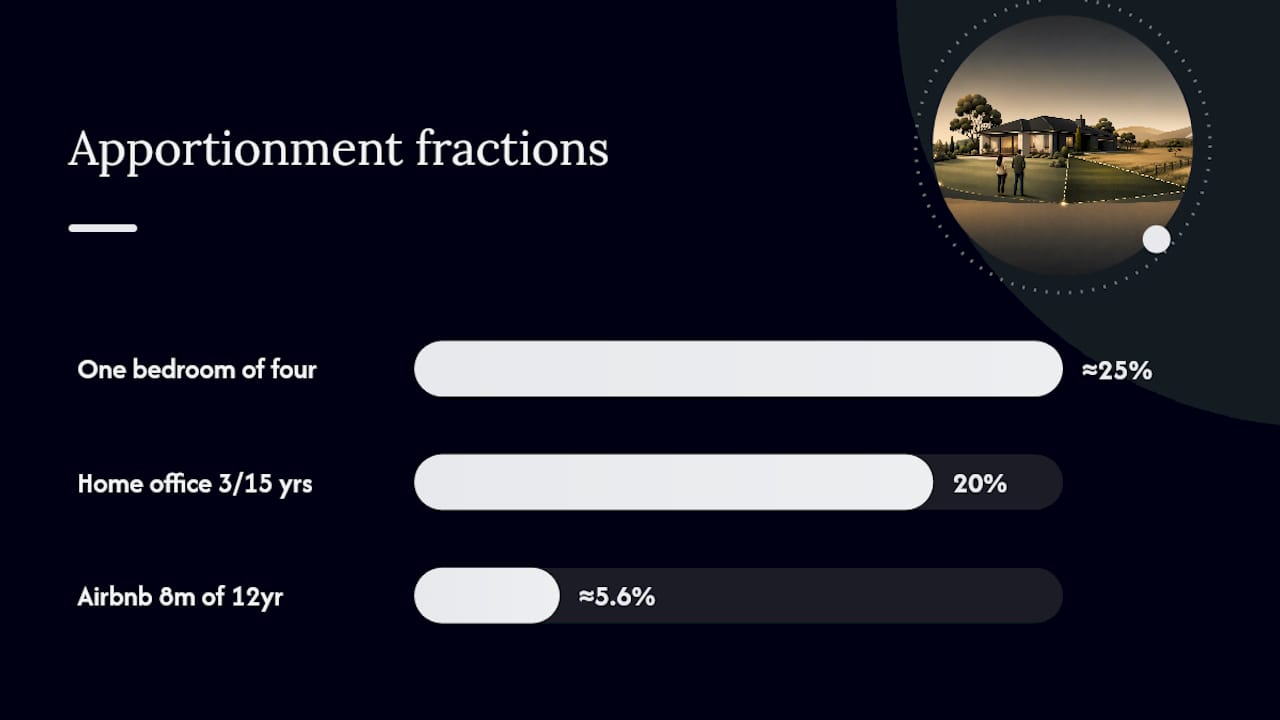
- By floor area. If you rented out one bedroom in a four-bedroom house, roughly a quarter of the home was income-producing. That share of any capital gain becomes taxable.
- By time. If you ran a consulting business from a home office for three of the fifteen years you owned the property, that's the fraction of the ownership period that counts as income-producing, applied against whichever area was used for it.
- By combination. A room rented on Airbnb for eight months of a twelve-year ownership period requires both the floor-area fraction and the time fraction to be applied together, which is where most people's back-of-envelope maths goes wrong.
A spare room let out on Airbnb for a few months a year is a smaller apportionment than a granny flat rented continuously for five years, even if the nightly rate was similar. The floor area matters as much as the duration.
One rule catches people off guard: the "first used to produce income" provision. If a property was rented out before you ever lived in it as your main residence, the cost base for CGT purposes resets to the market value on the date you first started living in it, not your original purchase price. That's often a better outcome for the owner, but it changes every calculation that follows, so it's worth checking which cost base actually applies before you do any modelling of your own.
The 6-year rule: treating a rented former home as your main residence
Moving out doesn't automatically end your main residence exemption. The ATO lets you continue treating a former home as your main residence for a period after you leave, and how long depends entirely on what you do with the place next.
- Left vacant: you can treat it as exempt for an unlimited period, provided you don't establish another main residence elsewhere.
- Rented out: the exemption continues for up to six years from the date you moved out.
- Sold after the six-year mark: any gain accrued from year seven onward is generally taxable, apportioned against total ownership.
The six-year clock isn't a one-off allowance you use once in your life. It applies separately each time you move out and rent the property, which matters if you've owned the same home through more than one absence.
Pro Tip: If you moved out, rented the place for four years, moved back in for a stretch, then moved out and rented it again, the six-year rule resets on the second absence. Keep a simple timeline of every "moved out" and "moved back in" date, because the ATO will want exactly that when you eventually sell.
The catch is you can only nominate one property as your main residence at a time (married couples and de facto partners can occasionally split this between two properties for a limited period, but that's a narrower exception). If you buy a second home and move into it while still owning the rented former residence, you generally need to choose which one gets the exemption for any overlapping period. Get that choice wrong, and you can inadvertently forfeit exempt status on the property you assumed was covered.
Working out your taxable gain and when to report it
Once you know which portion of ownership or floor space was income-producing, the actual sum is mechanical. Start with your cost base, the purchase price plus eligible costs like stamp duty, legal fees, and capital improvements. Subtract that from your sale price to get the raw capital gain. Then apply the apportionment formula the ATO uses for main residence cases:
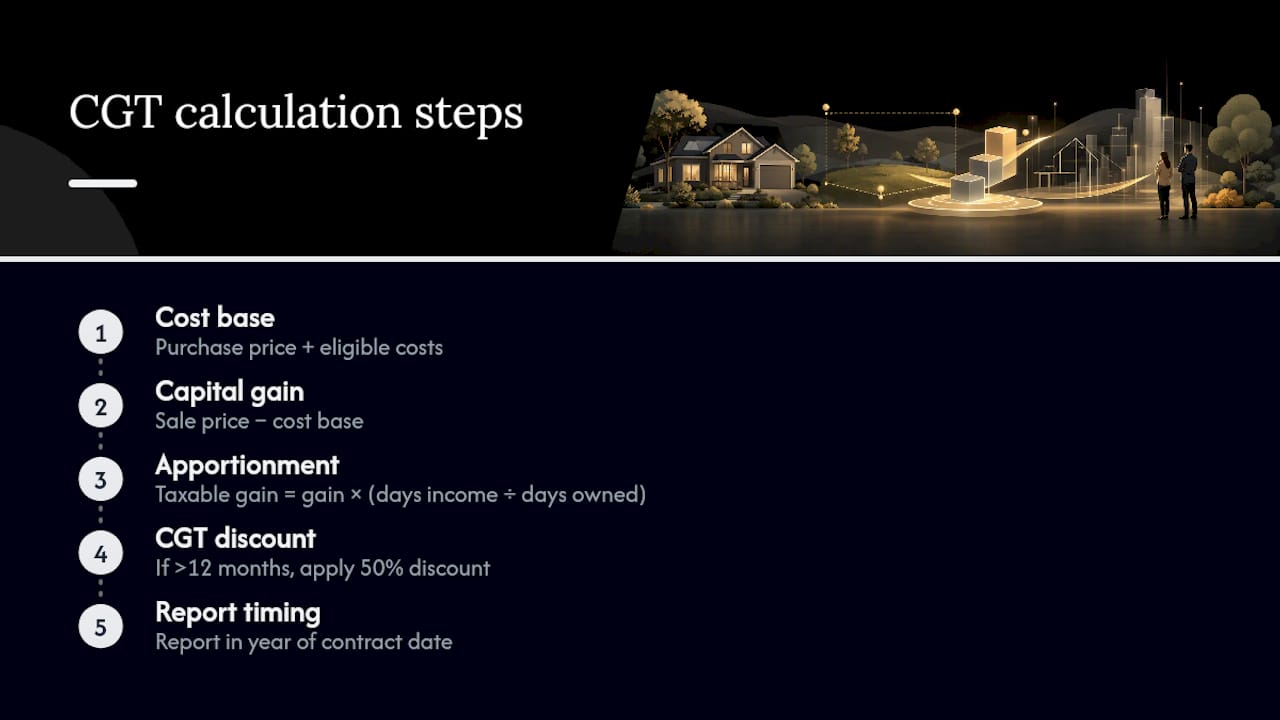
Taxable gain = Capital gain × (days used to produce income ÷ total days owned)
If you've held the property for more than twelve months, you're generally entitled to the 50% CGT discount on the taxable portion before it's added to your assessable income, which is worth checking against your CGT discount eligibility before you assume the full apportioned figure is what hits your tax return.
Timing trips up more sellers than the maths does. The CGT event is triggered on the date you sign the contract of sale, not the settlement date. If you exchange contracts in June but settlement falls in the following financial year, the gain is reported in the income year of the contract, not the year the money lands in your account.
Here's a worked example using the formula above:
That $33,000 is the figure that actually lands on the tax return, not the full $330,000 gain. Getting the days-owned denominator right, using calendar days rather than rounding to whole years, is where most manual calculations go slightly wrong. A modelling tool that lets you flex the rental period and sale date side by side, such as AlphaIQ's CGT calculator, removes that source of error entirely.
Common scenarios and a pre-sale checklist
Most people's CGT questions cluster around a handful of predictable situations. Here's how they typically play out:
- Moving house before selling the old one. If you buy a new home before selling the old one, you can generally treat both as exempt for up to six months, provided the old home was your main residence for at least three of the twelve months before the sale.
- Subdividing land. Subdividing your main residence block and selling one lot separately usually triggers CGT on the vacant lot, because the exemption attaches to the dwelling, not bare land sold on its own.
- Renovating or flipping. A quick renovate-and-sell cycle repeated across multiple properties can see the ATO treat the activity as a profit-making venture rather than genuine main residence use, which removes the exemption entirely.
- Deceased estates. Beneficiaries selling an inherited home within two years of the owner's death typically retain the full exemption, but delays beyond that window usually mean partial CGT applies from the date of death onward.
Before you sign a contract, run through a short checklist: confirm the exact dates you moved in and out, gather every document proving continuous occupation, calculate whether any part of the property was ever rented or used for business, check whether you've owned an overlapping second property at any point, and confirm your residency status hasn't changed for tax purposes. Selling an investment property that used to be your home carries its own layer of complexity worth understanding in detail before you list it.
A few red flags reliably shrink or remove the exemption: land over two hectares, any period the home was rented while you lived elsewhere beyond six years, a pattern of frequent buying and selling, and subdivided lots sold without a dwelling attached.
How AlphaIQ models CGT outcomes and why that helps
Working out the taxable portion of a sale by hand is manageable with one rental period and one sale date. It gets messy fast once you're testing multiple scenarios, different settlement dates, a longer or shorter rental stretch, or the six-year rule against an outright sale now.
AlphaIQ's tax-aware modelling lets you run those scenarios side by side rather than guessing which one lands closest to the ATO's formula. That's useful for:
- Comparing selling now versus waiting until you're inside or outside the six-year rental window.
- Testing how a partial exemption changes if you convert a rental back to your main residence before selling.
- Seeing the flow-on effect of a capital gain on your broader retirement and super position, not just the tax bill in isolation.
Modelling gives you a clear, numbers-based view of the likely outcome. It's indicative, not a substitute for a registered tax agent reviewing your specific facts before you lodge.
Where to check the official rules and useful tools
Every rule covered here traces back to primary ATO guidance, which is worth bookmarking rather than relying on secondhand summaries:
- Eligibility for main residence exemption sets out the core conditions, and the ATO's downloadable NAT 75488 fact sheet covers common scenarios in more depth.
- Using your home for rental or business explains apportionment for income-producing use.
- Treating former home as main residence covers the six-year rule in full.
- The six-year rule explained further offers another worked-through perspective if you want a second read on the mechanics.
Run your own numbers through AlphaIQ's CGT calculator before you commit to a sale date.
The eligibility-first approach beats the tax-time scramble
Most guidance on this topic gets the emphasis backwards. It leads with the calculation, the formula, the worked example, when the real decision point comes earlier: knowing before you sign anything whether your specific pattern of use, absence and rental history still qualifies for full or partial exemption.
The conventional advice treats the six-year rule as a simple countdown timer. It's not. It resets with every absence, interacts with whichever other property you're living in, and can be undone entirely by the "first used to produce income" cost base reset if you get the sequence wrong. That single provision has quietly cost people more in unexpected CGT than most apportionment errors combined.
If you take one thing from this, prioritise the dates. Contract date over settlement date. Every "moved out" and "moved back in" over a rough estimate. Get the timeline right first, and the arithmetic that follows is the easy part.
— Jonathan
Sources
- Eligibility for main residence exemption | Australian Taxation Office
- Treating former home as main residence | Australian Taxation Office