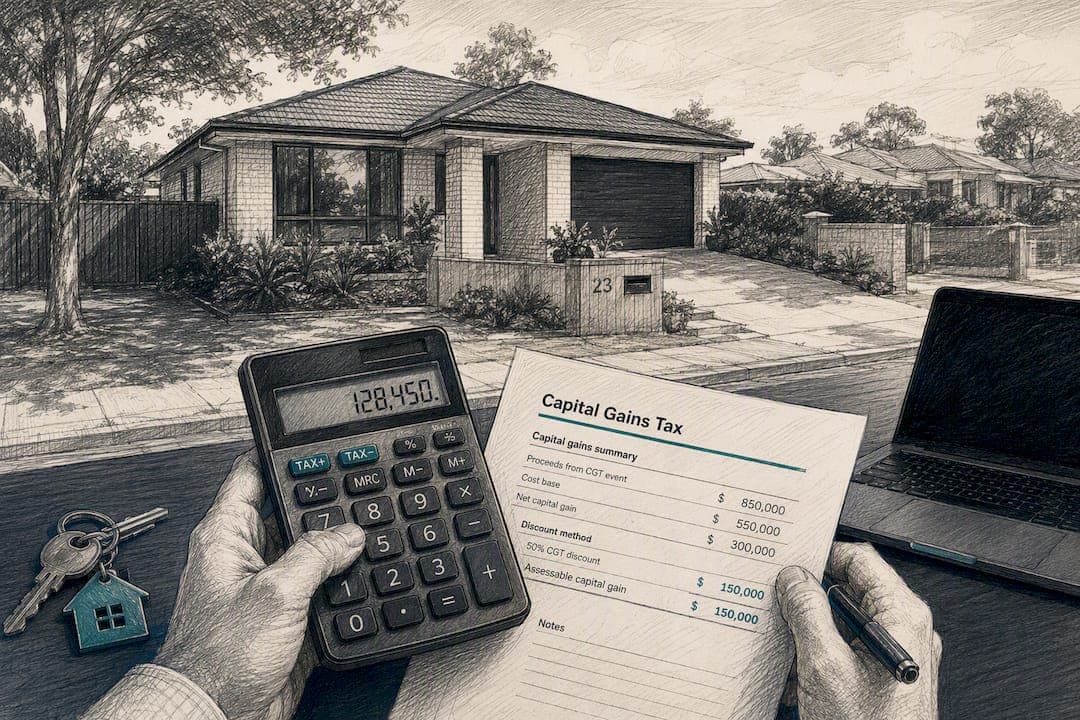
Yes, selling an investment property usually triggers a capital gain taxable to you, calculated the moment you sign the contract, not the day settlement closes. Your bill depends on four things: the size of the taxable gain, whether you've held the property over 12 months, how much depreciation you've claimed, and whether the net investment income tax applies on top.
Here's what drives the number:
- Taxable gain size — sale price minus your net adjusted cost base
- Holding period — under 12 months means ordinary income rates; over 12 months unlocks long-term rates
- Depreciation recapture — any depreciation you've claimed gets taxed separately, often at a higher effective rate
- NIIT exposure — a 3.8% surtax if your income clears the threshold
The next move: work out your net adjusted cost base before you do anything else. That single number determines almost everything downstream, from which tax bracket applies to whether a 1031 exchange is even worth the paperwork.
Key takeaways
Selling an investment property almost always creates a taxable event calculated from your net adjusted cost base, and the ownership period around that 12-month mark can shift your tax bill by tens of thousands of dollars.
| Point | Details |
|---|---|
| Use the contract date | The CGT event is triggered on the contract date, not settlement, and this decides your 12-month test. |
| Build your cost base properly | Add purchase price and documented improvements, subtract depreciation claimed, before comparing to sale proceeds. |
| Expect recapture separately | Depreciation claimed is recaptured at up to 25%, taxed apart from your standard long-term gain. |
| Check NIIT exposure | A 3.8% surtax applies on top of capital gains tax once income thresholds are exceeded. |
| Model before you list | Tools like AlphaIQ's tax-aware modelling help you test sale timing and exchange scenarios before committing to a date. |
Table of Contents
- How to calculate capital gains on investment property
- Short-term versus long-term rates, and where the NIIT fits in
- Depreciation recapture and its effect on your tax bill
- Legal ways to reduce or defer the tax
- A worked example: putting the numbers together
- What I keep seeing investors get wrong
- Where to check the rules yourself
- Test your numbers before you commit to a sale date
- Sources
How to calculate capital gains on investment property
The arithmetic isn't complicated, but the inputs trip people up constantly. Here's the sequence a proper calculation follows, mirroring the approach used in most reputable capital gains calculators:
- Start with your original purchase price, plus acquisition costs, closing fees, title insurance, and legal costs from when you bought.
- Add capital improvements — a new roof, a kitchen renovation, an added bathroom. Routine repairs (patching a wall, replacing a tap washer) don't count; they're already deducted as rental expenses.
- Subtract total depreciation claimed over the years you've owned it. This gives you your net adjusted cost base.
- Subtract that cost base, plus selling costs (agent commission, title fees, closing costs), from your sale price. What's left is your capital gain.
One detail catches almost everyone out: the CGT event date is the contract date, not settlement. If you sign a contract on 20 December 2025 but settlement doesn't happen until 15 January 2026, the IRS treats the sale as occurring in 2025 for timing purposes. That date also decides whether you clear the 12 month ownership threshold for long-term rates.
Pro Tip: Pull your depreciation schedule before you list the property, not after. Investors routinely underestimate cumulative depreciation, which understates their expected tax and leads to an unpleasant surprise at tax time.
The most common calculation errors: using the settlement date instead of the contract date, forgetting to add improvements because the receipts are long gone, and treating depreciation as a wash when it actually reduces your cost base and creates separate taxable income.
Short-term versus long-term rates, and where the NIIT fits in

The 12-month line is the single biggest lever on your tax bill. Sell an investment property you've held less than a year and the gain gets taxed as ordinary income, at your marginal rate, which can run well above 30% for higher earners. Hold it past 12 months and the gain qualifies for long-term capital gains treatment instead, under the federal brackets the IRS sets out: 0%, 15%, or 20%, depending on your total taxable income.
A rough way to sanity check your own number:
- Apply the long-term rate matching your income bracket to the gain portion
- Add 3.8% on top if your net investment income and modified adjusted gross income exceed the NIIT thresholds
- Remember these two taxes interact with your regular marginal rate, not replace it
A high-income seller can realistically face a 20% long-term rate plus the 3.8% surtax, an effective 23.8% federal rate before state tax even enters the picture. That's a meaningfully different outcome than someone in a lower bracket paying 15% with no NIIT exposure at all.
Depreciation recapture and its effect on your tax bill
Every dollar of depreciation you claimed while renting the property lowers your cost base, and lowering your cost base increases your reported gain. That's the mechanical link. But depreciation recapture goes further: the IRS treats the recaptured portion as a separate category from ordinary capital gain, and it's usually taxed less favourably.
The practical sequence:
- Total up every dollar of depreciation claimed across your ownership period
- That total becomes "unrecaptured Section 1250 gain," generally capped at a 25% rate rather than your standard long-term rate
- The remaining gain, above and beyond the recaptured amount, gets taxed at your normal long-term rate
Pro Tip: Keep every depreciation schedule from every tax year you've owned the property. If you've used different accountants over the years, reconcile the figures before you sell, don't assume they match.
Recapture is precisely why a naive "sale price minus purchase price" estimate almost always understates what you actually owe.

Legal ways to reduce or defer the tax
None of these are loopholes. They're standard, IRS-recognised mechanisms, and using them well comes down to timing and documentation.
- A like-kind exchange under Section 1031 lets you defer gain by rolling proceeds into a similar investment property. You've got 45 days to identify a replacement and 180 days to close, and the deferral only works if you reinvest the full proceeds into qualifying property, not just the gain.
- Hold past the 12-month mark if you're close to it. The jump from ordinary rates to long-term rates is often the single biggest tax saving available to you.
- Time the sale into a lower-income year, if a job change or retirement is on the horizon. Your capital gains bracket depends on total taxable income for the year.
- Document every capital improvement and keep valuations, since a higher, well-supported cost base directly shrinks your taxable gain.
- Harvest losses elsewhere in your portfolio to offset the gain, particularly useful if you're also selling underperforming stocks.
Pro Tip: A 1031 exchange defers tax, it doesn't eliminate it. Model the replacement property's numbers properly before committing, because a bad reinvestment can cost more than the tax you deferred.
A worked example: putting the numbers together
Take an investor who bought a rental property for $350,000, spent $40,000 on a kitchen and roof over the years, and claimed $60,000 in depreciation. They sell for $520,000, paying $31,000 in agent commission and closing costs.
- Net adjusted cost base: $350,000 + $40,000 − $60,000 = $330,000
- Net sale proceeds: $520,000 − $31,000 = $489,000
- Total capital gain: $489,000 − $330,000 = $159,000
- Depreciation recapture: $60,000, taxed at up to 25%, roughly $15,000
- Remaining gain: $99,000, taxed at the long-term rate
| Scenario | Tax treatment | Rough estimated federal tax |
|---|---|---|
| Sold at 10 months (short-term) | Full $159,000 gain at ordinary rates | Highest, potentially $50,000 to $58,000+ |
| Sold after 12 months (long-term) | $99,000 at 15 to 20%, plus $15,000 recapture at 25%, plus possible NIIT | Roughly tens of thousands of dollars |
| 1031 exchange into replacement property | Gain deferred, no current tax due | $0 due now, tax carries into replacement basis |
The gap between selling at month 10 versus month 13 alone can run into tens of thousands of dollars, purely from the ownership date.
What I keep seeing investors get wrong
The mistakes that cost people the most money are boring ones: using the settlement date instead of the contract date, tossing renovation receipts, and forgetting depreciation recapture exists until their accountant delivers the bad news. None of these are complex tax strategies gone wrong, they're basic record keeping gaps.
Running the numbers before you list, not after you've signed a contract, is what separates a planned sale from an expensive surprise. Scenario modelling catches these gaps early. Model it, or get a tax professional to check your figures, before you commit to a sale date.
— Jonathan
Where to check the rules yourself
Before making a final decision, verify your numbers against primary guidance rather than relying solely on a blog post, including this one.
- IRS — capital gains tax rates for definitions and the current long-term rate brackets
- IRS — net investment income tax for NIIT thresholds and how it interacts with capital gains
- A capital gains calculator to check your own inputs against a standard calculation model
Test your numbers before you commit to a sale date
A surprise tax bill is almost always a modelling failure, not a tax law failure. You had the numbers available; you just didn't run them against your actual holding period, depreciation schedule, and income bracket before signing.

AlphaIQ's tax-aware modelling lets you simulate a property sale against your real financial position, factoring in your marginal rate, NIIT exposure, and depreciation recapture, before you list. Instead of guessing what you'll net after tax, you can run the scenario properly and see how timing changes the outcome. Start with the super calculator to see how a property sale ripples through your broader retirement position, and treat any figures you get as a starting point for a conversation with a tax professional, not a replacement for one.
This article is general information, not a substitute for advice from a qualified financial advisor. Consult a qualified financial professional about your own circumstances before acting on anything here.