
This blog is Alphaiq's tax-aware modelling and scenario simulation resource, built specifically for self-directed Australian investors aged 35–65 who want to run retirement projections and test financial decisions without paying for ongoing human advice. Every post here gives you reproducible inputs you can model yourself: test CGT timing before selling property, stress-test your super drawdown against Age Pension means testing, or check whether your franked dividends actually qualify for a refund. The content draws on ATO guidance, ASIC's MoneySmart resources, and the Alphaiq platform's modelling engine, so you're working from authoritative Australian rules, not generic assumptions.
Key takeaways
Tax-aware modelling that includes ATO rules for franking credits, CGT timing, super caps, and Age Pension means testing produces materially different outcomes than models built on flat-return assumptions.
| Point | Details |
|---|---|
| Holding period rule is critical | Selling shares within 45 days of the ex-dividend date denies the franking tax offset entirely. |
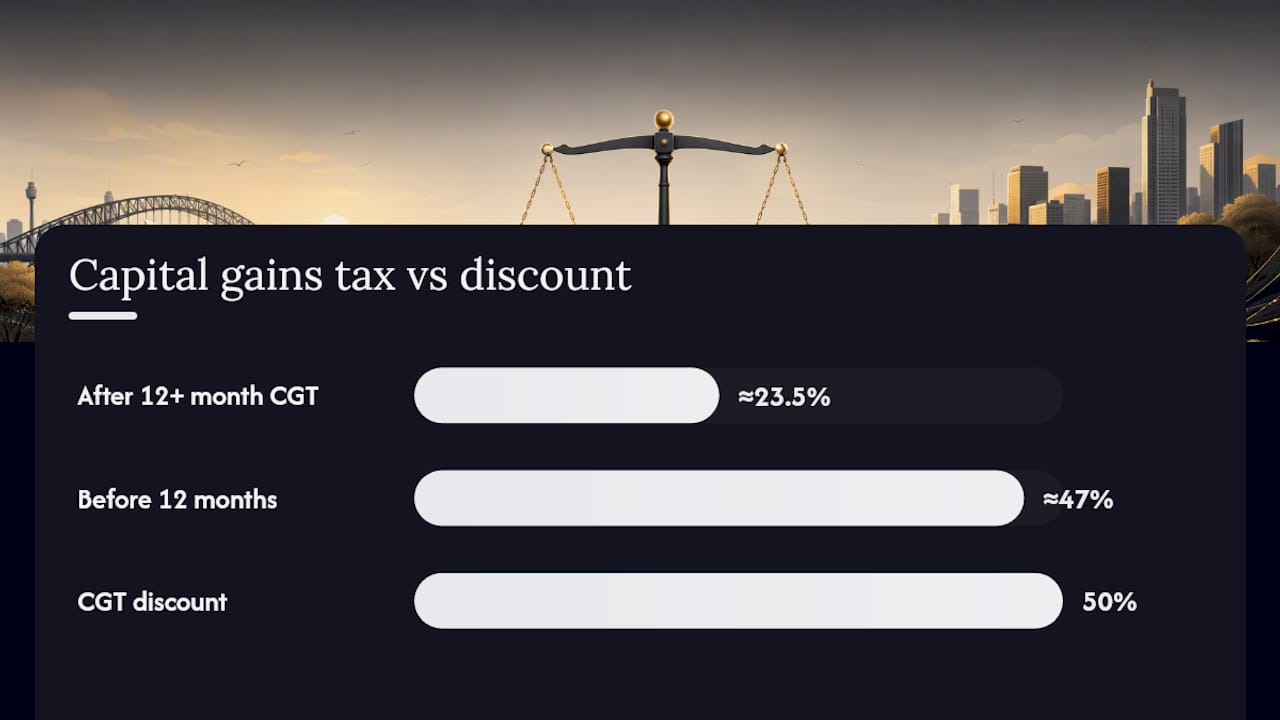
| CGT discount timing matters | Holding an asset past 12 months halves the taxable gain for individuals, cutting effective tax significantly. |
| Age Pension interactions shift safe spending | Models that recalculate means testing annually give different drawdown recommendations than those that ignore it. |
| Limitations must be stated | Legislative changes, market surprises, and model assumptions mean projections are not guarantees. |
| Alphaiq models all of this | The platform runs super projections, CGT events, franking credit checks, and Monte Carlo stress tests using current Australian rules. |
Table of Contents
- What does this financial advisor blog actually cover?
- Why tax-aware modelling changes your outcomes
- Primers on franking credits, CGT, super and debt recycling
- How scenario simulations and tax-aware models work
- Three worked scenarios you can replicate
- Who benefits from DIY modelling, and when should you get advice?
- Why Alphaiq publishes this blog
- Alphaiq puts these models in your hands
- Sources
What does this financial advisor blog actually cover?
This is a practical, Australia-first investment advice blog. Posts are structured around the decisions self-directed investors actually face, not broad theory.
Core post types you'll find here:
- Modelling walkthroughs — step-by-step guides to building tax-aware cashflow models in a spreadsheet or the Alphaiq platform
- Tax primers — concise explainers on franking credits, CGT, super contribution caps, and debt recycling rules
- Worked case studies — numbered examples with real inputs and outputs you can replicate (three are included in this post)
- Downloadable templates — spreadsheet starters pre-formatted for ATO-compliant CGT and super calculations
- Tool how-tos — guides to using Alphaiq's super calculator and franking credit tools
Typical posts include titles like "How to model a property sale CGT event before settlement" and "Carry-forward super contributions: when the numbers actually work." New posts publish regularly. To get notified and access Alphaiq's modelling tools, start a free trial at Alphaiq.
Why tax-aware modelling changes your outcomes
Tax-aware assumptions materially alter projected outcomes compared with naive models that apply a flat return and ignore Australian-specific rules. The difference is not marginal. A model that ignores Age Pension means testing, for example, may suggest a higher drawdown rate than is actually optimal, because it misses the point at which additional assets reduce your pension entitlement dollar for dollar.
Three areas where ATO rules shift the numbers most:
- Franking credits add a grossed-up return to dividend income that a tax-unaware model simply misses, especially for investors in lower tax brackets who can receive a cash refund.
- CGT discount timing means selling an asset one day before the 12-month mark costs you the 50% individual discount, which can shift your effective tax rate on a gain from roughly 23.5% to 47% at the top marginal rate.
- Age Pension means testing recalculates annually, so a model that ignores it will overstate safe spending by a meaningful amount for investors near the assets or income thresholds.
For tax-aware investing principles that shift long-run outcomes, the logic is the same: small rule-aware adjustments compound over a 20-year retirement horizon into large differences in after-tax wealth.
Pro Tip: The most common modelling oversight is ignoring the holding period rule for franking credits. If you sell shares within 45 days of acquiring them (90 days for some preference shares), you lose the franking tax offset entirely — even though the dividend is still assessable income. Always include the acquisition date as a model input.
Primers on franking credits, CGT, super and debt recycling
Franking credits and refund eligibility
When you receive a franked dividend, you include both the cash dividend and the attached franking credit in your assessable income. You then receive a franking tax offset equal to the credit amount. That offset can reduce your tax payable to zero, and if your basic tax liability is less than your total franking credits after other offsets, the ATO may refund the difference.
Key rules to include in every dividend model:
- Holding period rule: hold shares long enough around the ex-dividend date as required by tax rules, which is generally several weeks, longer for certain preference shares
- Related payments rule: if you make a related payment that passes the benefit of the dividend to someone else, entitlement is denied
- Dividend washing: purchasing shares solely to capture a franking credit without genuine economic exposure triggers integrity rules
- Small shareholder exemption: if your total franking credits are under $5,000 for the year, the holding period rule does not apply
For refund eligibility and how to apply, the ATO provides lodgment options including for investors who do not otherwise need to lodge a tax return. Use Alphaiq's franking credit calculator to estimate your after-tax dividend return quickly.
Capital gains tax basics
A capital gain equals the capital proceeds minus the cost base of the asset. For individuals who have held an asset for more than 12 months, the 50% CGT discount applies, halving the taxable gain before it is added to assessable income. The ATO's personal investors guide to CGT covers CGT events, cost base components, and special topics including small business concessions.
When your net capital gains exceed $10,000, you generally need to complete a CGT schedule. The CGT schedule instructions set out the capital gain/loss worksheet and CGT summary worksheet you should mirror in your model.
Superannuation projections
Key inputs for any super model include: concessional contribution cap ($30,000 per year for 2025–26), non-concessional cap ($120,000), carry-forward rules for unused concessional caps (available when your total super balance is below $500,000), and bring-forward arrangements for non-concessional contributions. Age Pension means testing interacts with super drawdowns, so a model that recalculates pension entitlement annually produces different safe-spending figures than one that ignores it.
Debt recycling
Debt recycling converts non-deductible mortgage debt into deductible investment debt by using investment income (or other funds) to pay down the home loan, then redrawing the same amount to invest. The tax benefit comes from the interest deductibility of the investment loan. Common pitfalls include mixed-purpose loan accounts (which destroy deductibility), failing to maintain a clear paper trail, and modelling the benefit without accounting for the risk that investment returns fall below the loan interest rate.

How scenario simulations and tax-aware models work
Models run forward-looking cashflow and tax calculations under repeated scenarios, either deterministically (fixed assumptions) or probabilistically (Monte Carlo). Monte Carlo simulations and historical stress tests expose sequencing risk and long-run failure probabilities more realistically than single-scenario projections, because they show the range of outcomes across thousands of return paths, not just the average.
Required inputs for a complete model:
Typical outputs:
Limitations to state clearly in any model: legislative changes (super caps, tax rates, pension thresholds) can shift outcomes significantly; market surprises are not captured by historical averages; and model outputs are projections, not guarantees. For online tools, check the privacy policy to confirm how your financial data is stored and whether it leaves your device.
Three worked scenarios you can replicate
Case study 1: retirement projection
Inputs: Age 52, super balance $480,000, salary $110,000, concessional contributions $27,500 p.a., planned retirement at 67, drawdown target $60,000 p.a.
Increasing drawdown to $70,000 p.a.
Case study 2: property sale and CGT
Inputs: Property acquired July 2019 for $620,000 (cost base including stamp duty and legal costs), sold March 2026 for $890,000.
Timing sensitivity: selling before the 12-month mark removes the discount and doubles the taxable gain to $270,000, adding roughly $46,575 in additional tax. Use Alphaiq's CGT calculator to test different sale dates and cost base components. For more CGT strategies for self-directed investors, the timing of disposal is consistently the highest-leverage variable.
Case study 3: dividend and franking credit planning
Acquisition date: 10 days before ex-dividend date.
| Scenario | Outcome |
|---|---|
| Holding period NOT met | Franking offset denied; full dividend taxable |
| Holding period MET (held 45+ days) | $600 franking offset applied; potential refund if tax < offset |
If your marginal rate is below the corporate tax rate, the excess franking credit may be refundable. If the holding period is not met, you pay tax on the full grossed-up dividend with no offset.
Who benefits from DIY modelling, and when should you get advice?
This blog and Alphaiq's tools suit you well if you:
- Are aged 35–65 and actively manage your own share or property portfolio
- Want to test scenarios before making decisions (selling an asset, making extra super contributions, starting a pension)
- Are comfortable working with spreadsheets or willing to use a guided modelling tool
- Seek scenario-based clarity rather than ongoing personalised advice
Seek a licensed financial adviser or registered tax agent when:
- Your situation involves a self-managed super fund (SMSF) with compliance obligations
- You have a complex trust structure or estate plan
- A Division 293 or Division 296 tax event is material to your position
- You are uncertain about the tax treatment of a specific asset or transaction
- You need personalised, regulated advice that accounts for your complete financial picture
This blog provides general financial education only. It is not personalised financial advice under the Corporations Act 2001. Always confirm current rules with the ATO or a licensed professional before acting.
Why Alphaiq publishes this blog
Building modelling tools for Australian investors has made one thing clear: the gap between a good financial decision and a costly one is almost always a tax rule that was not included in the model. Investors who understand how franking credits, CGT timing, and Age Pension means testing interact with their portfolio make materially better decisions, not because they are smarter, but because they are working with the right numbers.
This blog exists to close that gap. Every post is written to give you a reproducible model, a clear set of inputs, and an honest account of what the numbers show and where they fall short. Alphaiq's platform is built on the same principles: tax-aware, Australia-specific, and designed for investors who want to think clearly about their wealth without paying for advice they do not need.
That said, the platform is not a substitute for regulated personalised advice. When your situation is complex, a licensed adviser is the right call.
Alphaiq puts these models in your hands
Alphaiq is the practical alternative to building every scenario from scratch in a spreadsheet. The platform models superannuation projections, CGT events, franking credit refund eligibility, Age Pension means testing, and Monte Carlo stress tests in one place, using current Australian tax rules as the default assumptions.

You can run the retirement projection and property sale scenarios from this article directly in Alphaiq's tools. The super calculator handles contribution caps, carry-forward rules, and drawdown modelling. The CGT and franking tools let you test timing and holding period decisions before you act. A free trial gives you access to the core modelling features; paid features add full scenario comparison and sensitivity analysis.
When your situation moves beyond DIY modelling — SMSF compliance, complex estates, or a significant Division 296 event — a licensed adviser is the right next step. For everything else, start your free trial at Alphaiq and run your first scenario today.
Sources
- Franking tax offsets | Australian Taxation Office