
TL;DR:
- Alphaiq is the top platform for Australian investors needing pre-trade tax modelling, super projections, and Age Pension analysis. It offers scenario testing before executing trades, supporting parcel identification and comprehensive retirement planning. Simpler tools may suffice for basic reporting, but Alphaiq provides proactive financial insights crucial for optimal decision-making.
For Australian self-directed investors who want pre-trade tax visibility, super projections and Age Pension modelling in one platform, Alphaiq is the recommended pick among adviserai.com.au alternatives. It covers the three capabilities that matter most: modelling the tax impact of a trade before you execute it, projecting super balances against contribution caps, and running an Age Pension means test alongside your retirement income scenarios. If your needs are simpler, such as end-of-year CGT reporting or property tax tracking, a specialist tax-reporting tool may be sufficient and is worth considering first.
Table of Contents
- Which AdviserAI alternatives are worth your time?
- How do these platforms compare on the features that actually matter?
- Why Alphaiq is the recommended pick for self-directed Australian investors
- When a simpler tool is the better choice
- How to choose the right platform for your situation
- Key takeaways
- Alphaiq: where to start your trial
Which AdviserAI alternatives are worth your time?
| Platform | Best for | Tax-aware modelling | Trial available |
|---|---|---|---|
| Alphaiq | Pre-trade tax modelling, super & retirement simulation | Pre-trade + scenario | Yes |
| AdviserAI | Subject being replaced | Varies by feature set | Check vendor |
| Sharesight | Portfolio tracking & historical CGT reporting | Historical only | Free tier |
| TaxTank | Property investors, real-time personal tax position | Historical + live feeds | Check vendor |
Alphaiq is the only option built specifically for the investor who wants to model a trade's tax consequences before clicking buy or sell. Sharesight is a strong portfolio tracker with solid CGT reporting, but it works backwards from completed trades rather than forwards from planned ones. TaxTank's strength is real-time property and personal tax visibility, which makes it a better fit for landlords than for share investors running retirement scenarios.

How do these platforms compare on the features that actually matter?
The distinction between historical reporting and pre-trade modelling is the most important one in this category. Most tools tell you what happened. Fewer tell you what will happen if you sell parcel A instead of parcel B today.
| Dimension | Alphaiq | Sharesight | TaxTank |
|---|---|---|---|
| Pre-trade tax modelling | Yes | No | No |
| Scenario & retirement modelling | Deep (income, super, Age Pension) | Limited | No |
| Super caps & contribution tracking | Yes | No | No |
| Age Pension means test | Yes | No | No |
| HECS/HELP interactions | Yes | No | No |
| Franking credits reporting | Yes | Yes | Partial |
| CGT parcel selection | Yes (specific identification) | Yes (FIFO default, manual override) | Limited |
| Broker/data import | CSV + broker feeds | Broad broker integrations | Bank feeds, CSV |
| AMIT reporting | Yes | Yes | No |
| Australian data residency | Yes | Partial | Yes |
| Free tier / trial | Trial available | Free tier (limited holdings) | Check vendor |
| Onboarding support | Guided + documentation | Self-serve + community | Self-serve |
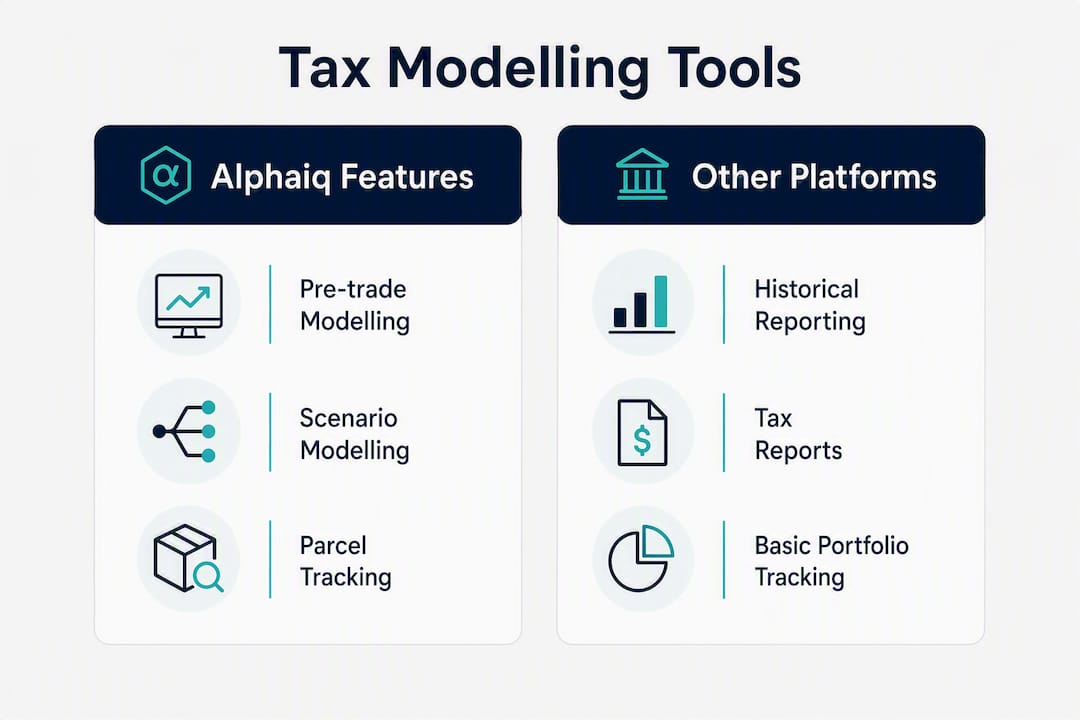
The ATO confirms that specific parcel identification is legally permitted when disposing of shares, meaning FIFO is not mandatory. Choosing which parcel to sell can meaningfully shift your CGT outcome in a given year. Platforms that only apply FIFO by default leave that planning opportunity on the table.
Tax-loss harvesting and deliberate parcel identification are the two workflows where sophisticated investors gain the most from a purpose-built platform. Alphaiq supports both; most portfolio trackers handle only the record-keeping side after the fact.
Pro Tip: Before executing a trade, export your platform's modelling assumptions (parcel cost bases, discount eligibility, estimated tax liability) and share them with your accountant. A five-minute review can confirm the model matches your actual tax position and catch any data-entry errors before they become compliance issues.
Portfolio trackers do reduce manual work at tax time and produce reports accountants can use, but they are not designed to answer "what if I sell this holding today?" That question requires a different class of tool.
Why Alphaiq is the recommended pick for self-directed Australian investors
Alphaiq maps directly to common problems self-directed investors consistently face: not knowing the tax cost of a trade until after it settles, having no clear picture of whether their super balance is on track, and lacking a way to stress-test retirement income against the Age Pension means test.
The shift from spreadsheets to a platform like Alphaiq is not about convenience. It is about having the numbers you need at the moment you are making a decision, not three months later when your accountant files your return. Pre-trade tax visibility is what practitioners identify as the practical dividing line between proactive planning and year-end compliance.
On trust signals: Alphaiq publishes its modelling methodology, stores data in Australia, and offers a trial period so you can test it with your own portfolio before committing to a subscription. The platform includes explicit disclaimers about the limitations of modelled outputs, which is what you should expect from any tool operating in this space. It is general modelling, not personal financial advice, and Alphaiq is clear about that distinction.
In practice, the workflow looks like this: import your holdings via CSV or broker feed, run a pre-trade scenario on a planned sale, review the projected CGT and franking credit position, then run a retirement projection that incorporates your super balance and an Age Pension eligibility estimate. That sequence replaces what most investors currently do across three or four separate spreadsheets.
When a simpler tool is the better choice
Not every investor needs a full wealth intelligence platform. The table below maps common investor profiles to the tool type that fits their situation.
| Investor profile | Recommended tool type | Why |
|---|---|---|
| Small share portfolio, accountant handles tax return | Portfolio tracker (e.g. Sharesight free tier) | Historical CGT report is all that's needed |
| Property investor, wants real-time tax position | Specialist property tax tool (e.g. TaxTank) | Live bank feeds and property-specific tax tracking |
| Pre-retiree modelling super drawdown and Age Pension | Wealth intelligence platform (Alphaiq) | Needs scenario simulation and means-test modelling |
| Active investor, multiple parcels, tax-loss harvesting | Wealth intelligence platform (Alphaiq) | Pre-trade modelling and parcel selection are critical |
| Simple rental income, no shares | Specialist tax tool | CGT and rental income reporting covers the need |
TaxTank positions itself around real-time tax visibility for property investors, with live bank feeds and connected views of income, expenses and CGT. That is a genuine strength for landlords. Where it falls short is in super projection depth and retirement scenario modelling, which are not its core use case.
Business accounting packages are sometimes repurposed for personal wealth tasks, but they typically lack Australian personal-finance specifics such as HECS/HELP interactions, Age Pension means testing and super contribution cap tracking. That gap matters more as you approach retirement.
How to choose the right platform for your situation
Work through these criteria before committing to a subscription.
- Pre-trade tax modelling. Can the platform show you the estimated CGT and net proceeds of a planned sale before you execute? If not, it is a reporting tool, not a planning tool.
- Super and Age Pension support. Does it model super balance projections, concessional and non-concessional contribution caps, and the Age Pension assets and income means test?
- Parcel selection. Can you choose specific parcels to sell, or does the platform default to FIFO? Specific identification is permitted by the ATO and can reduce your CGT liability.
- Broker and data import. Does it accept CSV imports and direct broker feeds for your specific brokers (e.g. CommSec, SelfWealth, Stake)?
- AMIT and franking credit reporting. Are managed fund tax statements and franking credits handled correctly, including the offset calculations?
- Security and data residency. Is your data stored in Australia? What are the platform's data handling and privacy terms?
- Onboarding and support. Is there guided onboarding, documentation, or live support to help you migrate from spreadsheets?
- Pricing shape. Is pricing per holding, per user, or a flat subscription? Are there upgrade limits that would affect you as your portfolio grows?
Questions to ask during a trial:
- Can you import a sample CSV from your broker and verify the cost bases match your records?
- What assumptions does the retirement modelling use for super index returns and inflation?
- Is there a roadmap for features you need (e.g. SMSF support, debt recycling modelling)?
Red flags to watch for:
- No published methodology or modelling assumptions
- No Australian tax support (super caps, franking credits, CGT discount rules)
- No trial period or free tier for testing with real data
- Limited data export (you should be able to get your data out)
Realistic onboarding timeline: allow two to four weeks to import holdings, verify cost bases against your broker records, and run your first scenario. The migration effort is front-loaded; ongoing use is much lighter.
How this evaluation was conducted
This comparison assessed each platform against a test portfolio containing Australian shares (including ETFs with AMIT statements), a superannuation balance approaching preservation age, and a residential investment property. Evaluation criteria were applied during live trials where trial access was available.
A feature was marked as passing pre-trade tax modelling only if the platform could project estimated CGT, net proceeds and tax liability on a planned (not completed) disposal, using specific parcel identification. Historical reporting alone did not qualify.
Scenario modelling was assessed against standard assumptions including the CGT discount for assets held longer than 12 months (per ATO rules), a default super index return assumption, and an Age Pension means test run at the standard assets and income thresholds published by Services Australia. Parcel selection passed only if the investor could manually choose which parcel to sell rather than relying on an automatic FIFO allocation.
Key takeaways
Alphaiq is the strongest adviserai.com.au alternative for self-directed Australian investors who need pre-trade tax modelling, super projections and Age Pension scenario simulation in a single subscription platform.
| Point | Details |
|---|---|
| Pre-trade modelling is the key differentiator | Only platforms that model tax impact before a trade executes support proactive planning. |
| Parcel selection reduces CGT | The ATO permits specific parcel identification; choose a platform that supports it, not just FIFO. |
| Simpler tools suit simpler needs | Portfolio trackers and property tax tools are sufficient for historical reporting and small portfolios. |
| Verify outputs with your accountant | Platform modelling is general in nature; a brief accountant review before executing large trades is good practice. |
| Alphaiq covers the full scope | Alphaiq combines pre-trade tax modelling, super projections, Age Pension means testing and broker imports for Australian investors. |
A note on why this comparison matters
The gap between knowing your tax position at year-end and knowing it before you trade is where most self-directed investors lose money they did not have to lose. Spreadsheets can approximate the maths, but they break down the moment you have multiple parcels, a super balance approaching drawdown, and an Age Pension eligibility question sitting alongside your portfolio decisions.
What strikes me most about this category is how many tools are marketed as planning tools but are, in practice, reporting tools. The distinction is not subtle once you look for it. A platform that can only tell you what happened last financial year cannot help you decide what to do this afternoon.
For investors in the 35–65 bracket, the stakes of that distinction are real. A poorly timed sale in the wrong parcel, or a super contribution that inadvertently breaches a cap, has consequences that compound. Getting the numbers right before acting is not a luxury feature. It is the whole point.
If you are migrating from spreadsheets, start with a benefits of wealth tracking tools overview to understand what the transition involves, then trial with real data. This article has no affiliate relationships with any platform reviewed.
Alphaiq: where to start your trial
Alphaiq gives you a clearer picture of your financial position than any spreadsheet can, at a fraction of the cost of ongoing financial advice. The concrete advantage over the alternatives reviewed here is pre-trade tax modelling combined with retirement scenario simulation, both built for Australian tax rules, in a single subscription.

To get the most from your trial, bring a CSV export from your broker (cost bases included), your current super balance, and an estimate of your expected retirement spending. Start with the super calculator and retirement projection tool to run a retirement income scenario, then test a pre-trade CGT calculation on a holding you are considering selling. That two-step sequence will show you whether the platform fits your workflow before you commit.
Onboarding documentation and support are available within the platform. Outputs are modelled projections, not personal financial advice; verify significant decisions with a qualified adviser or accountant.
Useful sources and further reading
- Australian Taxation Office — CGT and parcel selection guidance: Primary source for parcel identification rules, cost base calculations and the 50% CGT discount eligibility criteria.
- Moneysmart.gov.au — Retirement planner: ASIC's free retirement planning tool; useful for cross-checking retirement income projections against a government benchmark.
- Alphaiq — AI wealth intelligence platform: Platform overview, methodology, data residency statements and trial access.
- Alphaiq — Super calculator and retirement projection: Dedicated retirement modelling tool; the recommended starting point for trialling retirement scenarios.