
The CGT discount still applies in full today, provided you have held the asset for the required ownership period and you meet the residency test. That will not last. The Government has confirmed it will replace the discount from 1 July 2027 with cost base indexation and a 30% minimum tax on real capital gains. Gains that straddle the change date will be apportioned, so timing and valuations matter more now than they have in years.
TL;DR:
- The CGT discount applies only to assets held for at least 12 months by Australian residents and does not apply to companies or super funds, which have lower or no discounts.
- From July 2027, the 50% discount will be replaced by cost base indexation combined with a 30% minimum tax on real gains, making timing and inflation assumptions crucial.
- Gains accrued before July 2027 will need to be split between old rules and new regime, with options for valuation at the changeover date or proportional apportionment.
- Investors should model both current discount and future indexation scenarios using their actual figures before deciding whether to sell assets now or later.
- Precise recordkeeping of acquisition dates, costs, and valuations is essential to substantiate gains and minimize tax issues during current and transition periods.
Table of Contents
- How the 50% CGT discount works today
- Who qualifies and where the exclusions bite
- How to calculate the 50% CGT discount: a worked example
- What changes from 1 July 2027: indexation and the 30% minimum tax
- Transitional rules for gains that span 1 July 2027
- Practical actions to take before the rules change
- Why this shift changes how you should plan, not just what you owe
- Model your own numbers before the rules shift
- Sources
How the 50% CGT discount works today
The CGT discount currently reduces the taxable portion of a capital gain by half, and the mechanics haven't changed yet. You need to have owned the asset for at least 12 months before the contract of sale (not settlement), and the ATO's CGT discount guidance counts days inclusive of the acquisition date but not the disposal date. Miss the 12 month mark by even a few days and the discount disappears entirely.
Eligibility also depends on who owns the asset and where they live:
- Individuals must be Australian tax residents at the time the CGT event happens.
- Trusts can generally pass the discount through to resident beneficiaries.
- Companies are excluded outright, regardless of holding period.
- Complying superannuation funds get a reduced one third discount rather than 50%.
- Shares, managed fund units, and investment property typically qualify; trading stock, depreciating assets used solely for income, and most collectables held for profit do not.
Check your own circumstances against the ATO page before assuming eligibility, particularly if you have moved residency status during the ownership period.
Who qualifies and where the exclusions bite
Most confusion around the discount comes from a handful of recurring edge cases rather than the general rule.
- Companies never qualify for the 50% discount, no matter how long they've held the asset.
- Complying super funds receive one third off, not one half, reflecting their concessional 15% tax rate.
- Foreign and temporary residents generally cannot claim the discount on gains accrued while non-resident, and partial-year residency requires apportionment.
- Assets acquired before 20 September 1985 sit outside the CGT regime altogether and follow separate pre-CGT rules.
- Affordable housing investments can access an additional discount on top of the standard 50%, subject to specific criteria.
These categories carry enough nuance that the ATO and Treasury remain the authoritative references for anyone outside a straightforward individual, resident, post-1985 asset scenario.
How to calculate the 50% CGT discount: a worked example
Working out your discounted gain follows the same four steps whether you're selling shares or an investment property, as explained in high-income earner tax strategies.
- Add up your capital proceeds (the sale price, minus selling costs).
- Calculate your cost base: purchase price plus incidental costs like stamp duty, legal fees, and agent commissions.
- Subtract cost base from proceeds to get your nominal capital gain.
- If you've held the asset over 12 months and meet the residency test, halve that gain before adding it to your assessable income.
Say you bought shares for $40,000, paid $200 in brokerage, and sold them 18 months later for $70,000 after $300 in selling costs. Your cost base is $40,200, proceeds are $69,700, and your nominal gain is $29,500. Apply the discount and $14,750 gets added to your taxable income for the year, taxed at your marginal rate.
Pro Tip: Keep every contract note, settlement statement, and receipt for improvements or costs from the day you buy an asset. The ATO can ask for records years after disposal, and reconstructing a cost base from memory rarely ends well.

What changes from 1 July 2027: indexation and the 30% minimum tax
From 1 July 2027, the flat 50% discount disappears for gains accruing after that date. In its place, the 2026–27 Budget introduces cost base indexation using CPI, plus a 30% minimum tax applied to the real (inflation-adjusted) capital gain. Treasury confirms the policy intent is to tax genuine economic gains rather than the portion of a gain that simply reflects inflation eating away at purchasing power.
Key points investors should know:
- Indexation applies to the cost base of gains accruing from 1 July 2027 onward, not retrospectively.
- The 30% minimum tax sits alongside indexation, replacing the old discount mechanism entirely for new gains.
- New residential builds and affordable housing retain specific choices and exceptions under the draft legislation.
- Firms including EY and Baker McKenzie have flagged that indexation tends to favour long holds during high inflation, while short holds in low inflation periods can end up worse off than under the old discount.
Pro Tip: If you're weighing whether to sell before or after 1 July 2027, model both scenarios using your actual expected inflation assumptions. A generic rule of thumb will not capture how sensitive the outcome is to your specific holding period.
Transitional rules for gains that span 1 July 2027
Assets sold after 1 July 2027 that were acquired earlier will need their gain apportioned between the old and new regimes. The bill gives taxpayers a genuine choice here rather than a single mandated method.
- You can obtain a formal valuation as at 1 July 2027, locking in the market value at that date as your new cost base starting point.
- Alternatively, you can use an ATO-prescribed apportionment method that splits the gain proportionally across the ownership period.
- Whichever method you choose, retain the valuation report, purchase records, and any capital improvement documentation, since these substantiate your apportionment if the ATO ever queries the return.
For property and concentrated shareholdings, the choice between valuation and apportionment can shift your tax bill materially, so this isn't a decision to leave until the year of sale.
Practical actions to take before the rules change
The changeover rewards preparation, not last-minute scrambling. Here's a sensible order of operations.
- Confirm the exact acquisition date and contract terms for every asset you're considering selling, since the 12 month test and the 1 July 2027 cutoff both hinge on precise dates.
- Get a professional valuation now for property or illiquid assets you expect to hold past 1 July 2027, so you have a clean baseline for apportionment later.
- Model both outcomes: selling before the change under the current 50% discount, versus holding and dealing with indexation plus the 30% minimum tax afterward.
- Keep every cost base document, valuation, and improvement receipt in one place, because reconstructing this later is far harder than filing it as you go.
Pro Tip: Run the after-tax numbers under both regimes before you decide anything. A tool like AlphaIQ's CGT calculator can compare your outcome under the current discount against indexation and the 30% minimum tax, using your actual purchase price, dates, and expected inflation. Speak to a tax adviser if your position involves trusts, foreign residency history, or assets worth enough that getting the apportionment method wrong would be costly.
Why this shift changes how you should plan, not just what you owe
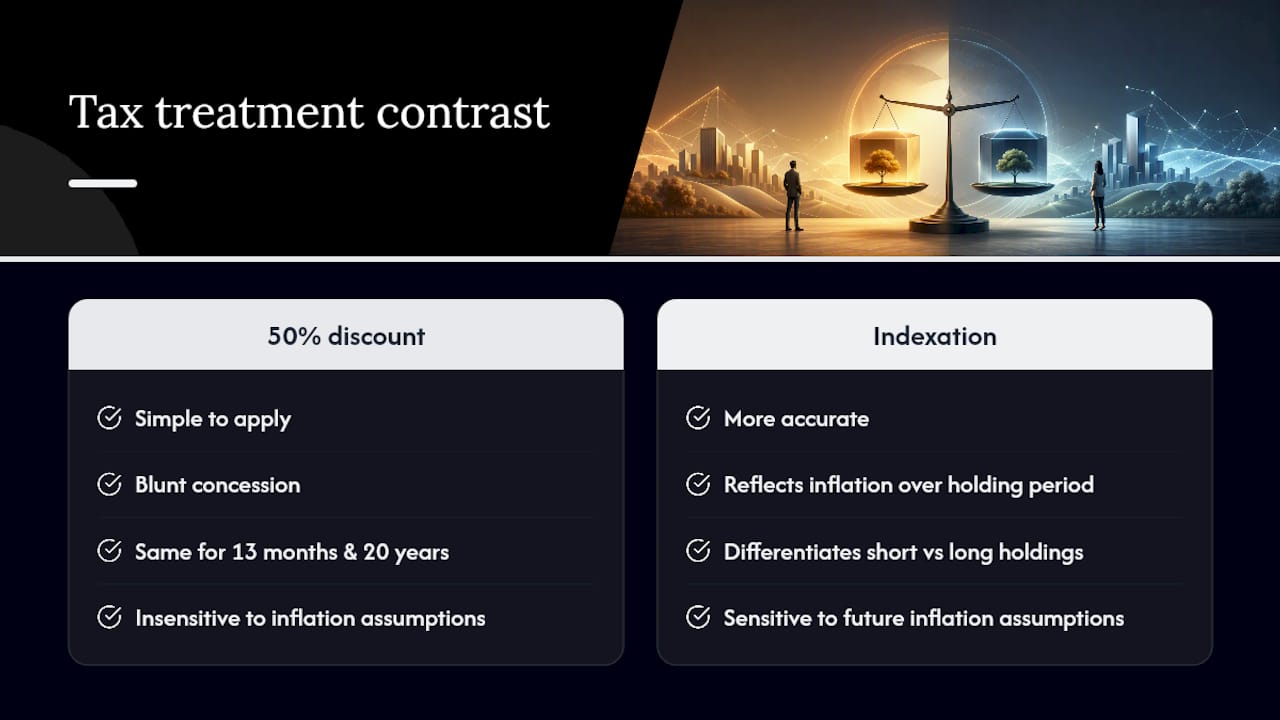
The move from a flat discount to an inflation-indexed regime is a genuine change in kind, not just degree. A 50% discount is simple to apply but blunt. It gives the same concession to someone who held an asset for 13 months in a high-inflation year and someone who held it for 20 years through a low-inflation decade. Indexation is more accurate but also more sensitive to assumptions about future inflation that nobody can know with certainty.
That's the part I think gets underappreciated in most commentary on this reform: the right answer now depends on scenario modelling rather than a single rule of thumb. Comparing outcomes under both regimes using your own numbers, not a generic example, is what actually tells you whether to act before 1 July 2027 or wait.
— Jonathan
Model your own numbers before the rules shift
The reforms replacing the 50% discount reward the investors who can see their own numbers clearly, not just the general rule. AlphaIQ's CGT calculator lets you plug in your actual acquisition date, cost base, and expected sale price to see the discounted gain today, and compare it against what indexation and the 30% minimum tax would produce after 1 July 2027.

If your capital gains sit alongside superannuation drawdown planning, the super calculator extends that same scenario testing into your retirement income projections, showing how a CGT decision today ripples through your after-tax cashflow years from now. Run a scenario with your own figures and see where the numbers actually land before you decide whether to sell now or hold.
This article is general information, not a substitute for advice from a qualified financial advisor. Consult a qualified financial professional about your own circumstances before acting on anything here.
Sources
- CGT discount | Australian Taxation Office
- Tax reform | Budget 2026–27
- Budget 2026-27 tax system changes | The Treasury
- Treasury Laws Amendment (Tax Reform No.1) Bill 2026 — Parliament of Australia
- Australia's 2026-27 Federal Budget | EY - Global