
TL;DR:
- The best Australian-focused financial tools fall into categories like tax-aware portfolio trackers, retirement modelling engines, personal finance apps, and hybrid AI platforms. Alphaiq stands out as a comprehensive platform supporting parcel-level CGT, franking credits, super projections, and scenario simulation in one interface. Verifying parcel-level CGT handling and ATO-ready exports is essential before switching to any new platform.
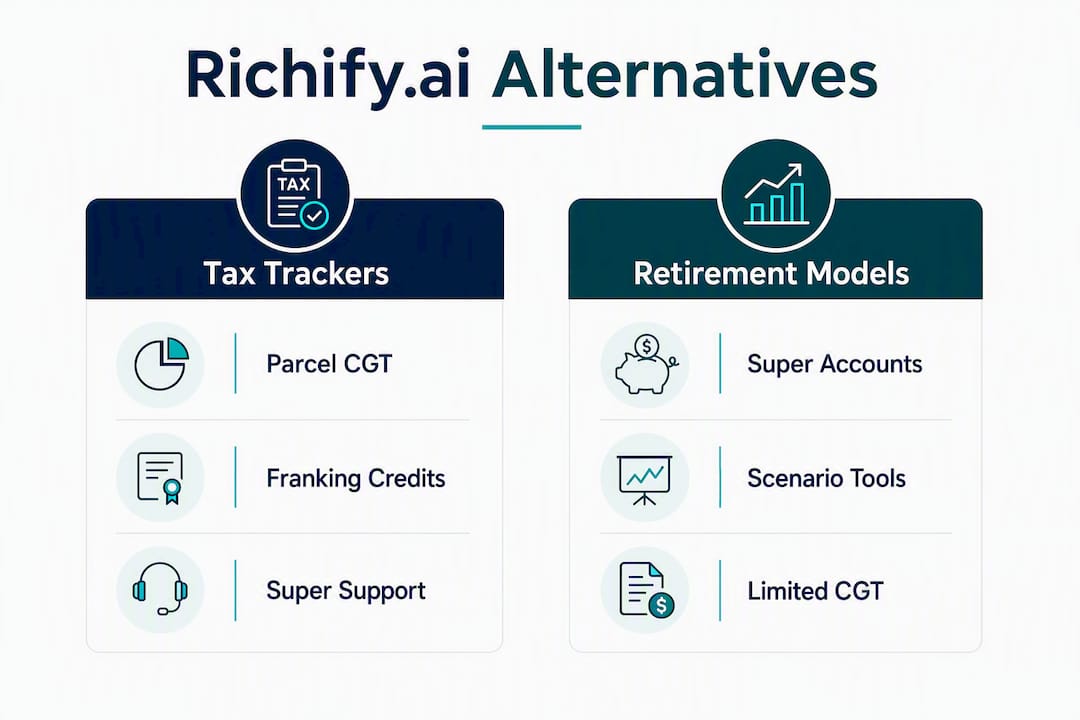
For Australian investors who need more than net worth tracking, the strongest Richify.ai alternatives fall into four categories: tax-aware portfolio trackers (parcel-level CGT, franking credits, ASX broker sync), retirement modelling and scenario engines (super projections, withdrawal sequencing, debt recycling), budget-first personal finance apps (spending visibility, open banking), and hybrid AI wealth platforms. Alphaiq is the recommended Australian-built option for investors who want tax-aware modelling and scenario simulation in one place.
Quick shortlist by use case:
- Tax-aware portfolio trackers — best for ASX investors who need ATO-ready CGT reports and franking credit handling without a spreadsheet
- Retirement modelling and scenario engines — best for pre-retirees who want to model super drawdowns, preservation age timing, and withdrawal sequencing under Australian rules
- Budget-first personal finance apps — best for casual users who want spending visibility and bank account aggregation with minimal setup
- Hybrid AI wealth platforms (Alphaiq) — best for self-directed investors aged 35–65 who want to model capital gains, debt recycling, franking credits, super projections, and retirement income in one place, without paying for ongoing advice
TL;DR: If your priority is tax reporting and CGT accuracy, go with a specialist portfolio tracker. If you are planning retirement or modelling super, choose a scenario engine or Alphaiq. If you just want to see where your money goes, a budget app is enough.
Table of Contents
- How do the best Richify.ai alternatives compare on Australian tax features?
- What does each alternative category actually offer Australian users?
- How do you choose the right Richify alternative for your situation?
- How to migrate from Richify to a new platform safely
- Why does Australia-specific tax modelling actually matter?
- Which alternative category should you trial first?
- Key takeaways
- Why tax-aware modelling is the lens we use for every recommendation
- Alphaiq: the Australian-built alternative worth trialling
- Useful sources and vendor documentation to verify AU tax and reporting claims
How do the best Richify.ai alternatives compare on Australian tax features?
The table below covers the dimensions that matter most for Australian investors: CGT handling, super support, AI capability, broker integrations, and migration options.
| Category | Best for | AU tax & super support | AI assistant | AU bank & broker integrations | Portfolio & tax reporting | Mobile / web | Pricing shape | Ease of use | Data security | Migration / import |
|---|---|---|---|---|---|---|---|---|---|---|
| Tax-aware portfolio tracker | ASX investors needing ATO-ready reports | Parcel-level CGT, franking credits, DRP handling | Limited or none | ASX brokers (CommSec, SelfWealth, CMC), read-only | Parcel-level, accountant-ready exports | Web-first, some mobile | Free tier available; paid from ~$10/month | Moderate | Read-only broker links; no login sharing | CSV, broker export, manual entry |
| Retirement modelling engine | Pre-retirees modelling super and withdrawal | Super account types, tax estimation, cash-flow projections | Scenario simulation | Limited direct integrations; manual data entry | Projection-focused; less suited to live CGT | Web-first | Subscription; free trial common | Moderate to complex | User-controlled data | CSV, manual |
| Budget / personal finance app | Casual users tracking spending | Basic; limited CGT or franking support | AI spending insights | Open banking, major AU banks | Minimal tax reporting | Mobile-first | Free tier; premium ~$10–$20/month | Easy | Bank-grade encryption | Open banking, CSV |
| Hybrid AI wealth platform (Alphaiq) | Self-directed investors, pre-retirees | CGT, franking credits, super projections, debt recycling, retirement income | Tax-aware scenario modelling | Investments, super, property | Parcel-level modelling, ATO-aware scenarios | Web | Subscription after trial | Moderate | AU-based, purpose-built | CSV, manual, guided import |
Pricing highlights by category:
- Portfolio trackers typically offer a free tier for a limited number of holdings, with paid plans scaling by portfolio size or number of transactions.
- Retirement modelling engines are usually subscription-only, with free trials ranging from 7 to 30 days.
- Budget apps tend to lead with a free tier and upsell premium features such as investment tracking or tax summaries.
- Hybrid platforms like Alphaiq operate on a subscription model after a trial period, with pricing reflecting the depth of modelling and scenario features.
Callout: ATO-ready exports, parcel-level CGT matching, and franking credit handling are the three features most commonly missing from international tools repurposed for Australian users. Verify each one before committing to any platform.
What does each alternative category actually offer Australian users?
Tax-aware portfolio trackers
These tools are built around one core job: tracking every share parcel you own, matching it to the right cost base, and producing a report your accountant can use at tax time. Parcel-level tax reporting and CGT optimisation tailored to ATO expectations are the defining features of this category.

Platforms in this space support direct links to Australian brokers such as CommSec, SelfWealth, and CMC, with read-only access so your login credentials are never shared. Corporate actions, dividend reinvestment plans (DRPs), and currency conversion are handled automatically on the better platforms. Entity-aware reporting (individual, company, trust, SMSF) is available on more advanced tools.
Who it suits: ASX investors with multiple parcels across different acquisition dates, SMSF trustees, and anyone who has received DRPs or bonus shares.
Typical pros:
- Parcel-level CGT accuracy with 50% discount applied correctly
- Franking credit gross-up handled automatically
- Accountant-ready export formats
Typical cons:
- Limited retirement or scenario modelling
- Minimal budgeting or spending visibility
Migration note: Most accept CSV imports from broker platforms and manual entry for older parcels. Broker links are read-only. Bring your original contract notes for any parcel predating your broker's digital history.
| Feature | Tax-aware portfolio tracker |
|---|---|
| Parcel-level CGT | Yes |
| Franking credits | Yes |
| Super projections | No |
| ASX broker sync | Yes (read-only) |
| Typical pricing | Free tier; paid from ~$10/month |
Retirement modelling and scenario engines
ProjectionLab and similar tools model Australian superannuation account types and provide scenario engines for withdrawal sequencing, tax estimation, and cash-flow projections across retirement. These platforms let you test strategies like debt recycling, negative gearing, and retirement withdrawal timing under Australian rules.
Who it suits: Pre-retirees aged 50–65 who want to model when to access super, how to sequence withdrawals, and what different contribution strategies mean for their final balance.
Typical pros:
- Built-in Australian super account types
- Scenario testing for debt recycling and withdrawal sequencing
- Cash-flow projections across a multi-decade retirement
Typical cons:
- Not designed for live CGT tracking or parcel-level reporting
- Manual data entry is common; fewer direct integrations
Migration note: These tools typically accept CSV for historical data. Super balances and contribution histories are entered manually or imported from fund statements.
Pro Tip: When trialling a retirement modelling engine, run the same scenario with and without the 50% CGT discount applied to a long-held parcel. If the tool does not differentiate, it is not calculating correctly for Australian conditions.
| Feature | Retirement modelling engine |
|---|---|
| Parcel-level CGT | Limited |
| Super projections | Yes |
| Scenario modelling | Yes |
| ASX broker sync | Limited |
| Typical pricing | Subscription; free trial common |
Budget and personal finance apps
Apps like MoneyBrilliant, Frollo, and Canwi sit in this category. They connect to Australian bank accounts via open banking or screen scraping, categorise transactions, and give you a clear picture of where your money goes. YNAB (You Need A Budget) takes a more structured approach, built around zero-based budgeting where every dollar is assigned a job before it is spent.
These tools are genuinely useful for spending awareness and short-term cash flow. Where they fall short for serious investors is on the tax side: CGT parcel tracking, franking credit handling, and super projections are either absent or superficial.
Who it suits: Casual users, first-time budgeters, and anyone who wants a simple dashboard of income and expenses without the complexity of investment tax reporting.
Typical pros:
- Easy setup with open banking connections
- Mobile-first, intuitive interfaces
- Free tiers available
Typical cons:
- No parcel-level CGT or ATO-ready reports
- Super and investment tracking is basic at best
Migration note: Open banking connections transfer automatically. Historical transaction data can usually be exported as CSV from your existing app.
Hybrid AI wealth platforms
This is where Alphaiq sits. Rather than tracking spending or producing a single tax report, a hybrid platform models your entire financial position: investments, super, property, debt, and retirement income, all under Australian tax rules. The AI component runs scenario simulations, so you can see what debt recycling does to your after-tax position, or how a change in super contributions shifts your retirement income.
Sharesight is worth noting as a well-regarded portfolio tracker with strong franking and CGT support, though it focuses on reporting rather than forward-looking scenario modelling. For investors who want both live reporting and retirement scenario simulation, a hybrid platform covers more ground.
How do you choose the right Richify alternative for your situation?
Start with your primary need. The gap between a budget app and a tax-aware modelling platform is significant, and choosing the wrong category wastes time during migration.
If tax reporting is your priority
You need parcel-level CGT support, franking credit handling, and ATO-ready exports. Ask any vendor directly: does the platform track individual share parcels with their original acquisition dates? Does it apply the 50% CGT discount automatically for assets held longer than 12 months? Does it handle DRPs and bonus shares as separate parcels? If the answer to any of these is unclear, that is a red flag.
Watch for incomplete franking handling. Some platforms record dividend income but do not gross up for the franking credit, which means your taxable income and the associated tax offset are both wrong. For a portfolio generating meaningful franked dividends, this is not a minor rounding error.
If retirement modelling is your priority
You need a platform that understands Australian super account types (accumulation, pension phase, transition to retirement), preservation age rules, and the tax treatment of different withdrawal strategies. Tax-aware investing materially changes recommended strategies at this stage of life, so a generic retirement calculator built for another market will not give you accurate numbers.
If budgeting is your priority
A budget app is the right starting point. Set up open banking connections, run it for 60–90 days to understand your spending patterns, and revisit whether you need more depth once you have a clear baseline.
Questions to ask any vendor
- Does the platform support SMSF or trust entities, or only individual accounts?
- Are CGT reports exportable in a format your accountant can use directly?
- What happens to your data if you cancel your subscription?
- Are there additional fees for annual tax reports, professional exports, or historical data access?
Pro Tip: Always ask whether the platform charges separately for CGT reports or ATO-ready exports. Some platforms advertise low monthly fees but charge $30–$80 per tax report at year end, which changes the true annual cost significantly.
How to migrate from Richify to a new platform safely
The safest migration takes about two to four hours for a typical portfolio. Rushing the reconciliation step is where most users introduce CGT errors that only surface at tax time.
-
Export everything from Richify first. Download your full transaction history as CSV, including all investment parcels, super balances, property values, and HECS/HELP balances. Export any documents or receipts stored in the platform. Save these files in a dedicated folder before you do anything else.
-
Map your data fields before importing. Different platforms use different column names and date formats. Before uploading your CSV to the new platform, check that acquisition dates, cost bases, and parcel quantities map correctly. A mismatch in date format (DD/MM/YYYY vs MM/DD/YYYY) will corrupt your entire CGT history.
-
Import to the new platform and reconcile opening balances. After import, compare your total portfolio value and individual parcel quantities against your broker statements. Do not rely on the platform's confirmation screen alone. Cross-check at least five to ten parcels manually.
-
Preserve all original broker contract notes. This is the most commonly overlooked step. Parcel-level allocation mistakes after migration are the leading cause of incorrect CGT reporting. Your original contract notes are the source of truth for acquisition date and cost base. Forward copies to your accountant and keep them in your own records permanently.
-
Verify ATO-readiness before your first tax year on the new platform. Run a test CGT report for the prior financial year and compare it against your previous return. Check that the 50% discount is applied correctly, that franking credits are grossed up, and that DRPs appear as separate parcels with their own cost bases.
-
Check HECS/HELP and super splits separately. These do not always import cleanly from net worth trackers. Enter super balances manually from your most recent fund statement and verify HECS/HELP balances against the ATO's online services.
Reconciliation checklist before committing to the new platform:
- Total portfolio value matches broker statements within rounding
- Individual parcel quantities and acquisition dates are correct
- Franking credits are recorded and grossed up
- DRPs appear as separate parcels, not as cash dividends
- Super balance matches fund statement
- CGT report for a prior year matches your lodged return
For guidance on CGT parcel strategies during and after migration, the Alphaiq blog covers the key decision points in detail.
Why does Australia-specific tax modelling actually matter?
Australian tax and super rules materially change after-tax returns and recommended strategies in ways that international tools simply do not account for. This is not a minor gap. For a self-directed investor with a diversified ASX portfolio, the difference between correct and incorrect CGT handling can run to thousands of dollars per year.
Automated parcel-level tax reporting and CGT optimisation tailored to ATO expectations are features that directly affect the tax you pay, not just the reports you file. When a platform matches each sale to the right parcel, applies the 50% CGT discount to assets held longer than 12 months, and grosses up franked dividends correctly, your tax position is accurate. When it does not, you either overpay or face an ATO adjustment.
The superannuation dimension adds another layer. Scenario engines built for Australian super model the tax treatment of accumulation versus pension phase, the impact of concessional and non-concessional contributions, and the sequencing of withdrawals in a way that a generic retirement calculator cannot replicate. Getting this wrong does not just produce an inaccurate projection; it can lead to a suboptimal contribution strategy that costs real money over a 10–20 year accumulation horizon.
International tools repurposed for Australian users frequently lack the tax logic required for accurate CGT and super handling. For investors with complex holdings across trusts, companies, and SMSFs, parcel-level control and manual allocation features are frequently cited as must-haves by accountants and advanced DIY investors. A platform that cannot distinguish between a parcel held 11 months and one held 13 months is not fit for purpose in the Australian context.
For a deeper look at how tax-aware strategies boost returns across different asset classes, the evidence is consistent: the after-tax return gap between tax-aware and tax-unaware approaches compounds significantly over time.
| Tax feature | Why it matters for Australian investors |
|---|---|
| Parcel-level CGT | Determines which discount applies and which parcels to sell first |
| Franking credit gross-up | Affects taxable income and the tax offset you can claim |
| Super phase tracking | Changes the tax rate applied to earnings and withdrawals |
| DRP as separate parcels | Each reinvestment is a new acquisition with its own cost base |
| SMSF / trust entity support | Different tax rates and reporting obligations apply |
Which alternative category should you trial first?
The right starting point depends on what you are trying to solve.
- Casual budgeter: Start with a budget-first app. Connect your bank accounts, run it for 60–90 days, and assess whether you need more depth. The cost is low and the setup is fast.
- Tax-aware ASX investor: Go directly to a specialist portfolio tracker or Alphaiq. Verify parcel-level CGT and franking credit handling before you import your full history. Run a test report against a prior year's return.
- Pre-retiree or retirement planner: Choose a scenario engine or Alphaiq. The critical test is whether the platform models your specific super account type, preservation age, and withdrawal sequencing correctly under current Australian rules. Retirement calculators built for Australian investors explain what to look for in a projection tool.
- AI-curious investor: Alphaiq is the Australian-built option that combines tax-aware modelling with scenario simulation. The AI component is not a chatbot; it runs financial scenarios across your actual data so you can see the numbers before you make a decision.
Best first step for every profile: trial with a small, representative data set before importing your full history. Import three to five parcels, run a CGT scenario, and check the output against your own records. If the numbers do not match, resolve the discrepancy before you commit.
Key takeaways
For Australian investors evaluating Richify.ai alternatives, the single most important feature to verify is parcel-level CGT handling with ATO-ready exports, because this is where international and budget tools most commonly fall short.
| Point | Details |
|---|---|
| Match category to your primary need | Tax reporting, retirement modelling, budgeting, and AI scenario simulation are distinct categories with different strengths. |
| Parcel-level CGT is the critical AU feature | Verify that the platform tracks individual parcels, applies the 50% discount correctly, and handles DRPs as separate acquisitions. |
| Migrate carefully and preserve contract notes | Export all data from Richify before switching; original broker contract notes are the source of truth for cost base. |
| Trial with test data before full import | Import a small representative sample, run a CGT report, and reconcile against your own records before committing. |
| Alphaiq covers tax, super, and scenario modelling | Alphaiq is the Australian-built platform that combines parcel-level CGT, franking credits, super projections, and retirement scenario simulation in one place. |
Why tax-aware modelling is the lens we use for every recommendation
Most comparison articles about personal finance apps treat all features as roughly equal and let price be the tiebreaker. That framing works for budgeting tools, but it is the wrong lens for Australian investors who are managing real tax obligations and approaching retirement.
The Australian tax system rewards investors who understand it. The 50% CGT discount, franking credit offsets, and the tax treatment of super in pension phase are not edge cases; they are central to how a well-structured portfolio performs over time. A platform that gets these wrong does not just produce a bad report. It can lead you to sell the wrong parcel, miss a tax offset, or model a retirement income that does not reflect what you will actually receive.
The tools recommended here are not ranked by price or interface polish. They are ranked by whether they handle the features that materially affect your financial outcomes in Australia. For investors who want to model those outcomes with confidence, Alphaiq is built specifically for that job.
Alphaiq: the Australian-built alternative worth trialling
If parcel-level CGT, franking credits, and super projections are your priorities, Alphaiq is the Australian-built platform designed for exactly that. Where budget apps give you spending visibility and portfolio trackers give you tax reports, Alphaiq models your entire financial position: investments, super, property, debt, and retirement income, all under Australian tax rules and with scenario simulation built in.

The platform runs on a subscription model after a trial period, so you can test it with your own data before committing. During your trial, import a sample CSV of your share parcels, run a CGT scenario on a parcel held longer than 12 months, and check the super projection against your fund statement. If you are planning for retirement, use the superannuation calculator to model your projected balance under different contribution strategies.
Alphaiq is built for self-directed investors aged 35–65 who want to make confident, well-modelled financial decisions without paying for ongoing advice. Start your trial at alphaiq.pro and verify the numbers against your own records before you decide.
Useful sources and vendor documentation to verify AU tax and reporting claims
| Source | What it covers | Why it is relevant |
|---|---|---|
| TrackMyShares — Portfolio tracker for Australian investors | ASX and international holdings, franking gross-up, 50% CGT discount, read-only broker links | Verify franking credit and CGT discount handling; confirms no broker login required |
| ProjectionLab — Financial and retirement planning tools for Australia | Australian super account types, scenario engines, tax estimation, cash-flow projections | Verify super modelling depth and scenario testing capability |
| Metrifly — Portfolio tracker and Australian tax reports | Parcel-level matching, broker linking (CommSec, SelfWealth, CMC), entity-aware CGT reports | Verify parcel-level accuracy and broker integration scope |
| TaxTank — Personal finance software | Continuous tax position tracking, receipt archiving, ATO-ready reporting | Verify year-round tax tracking and audit documentation features |
| Richify — Net worth tracker Australia | AU-focused multi-asset tracking: ASX, super, property, HECS/HELP | Reference for understanding Richify's feature set before switching |
| Alphaiq — CGT Calculator Australia | Free CGT calculation tool for Australian investors | Use during migration to spot-check parcel-level CGT outputs |
| Alphaiq — CGT Discount Australia guide | 50% CGT discount rules, timing, and record-keeping requirements | Verify discount eligibility and documentation requirements |
| Alphaiq — Tax-aware investing | Why tax-aware modelling affects long-term wealth outcomes in Australia | Background on the financial case for tax-aware platform selection |
This article provides general information about personal finance tools and categories available to Australian investors. It is not financial, tax, or legal advice. Verify current ATO rules and platform capabilities with the relevant vendor or a qualified Australian tax professional before making decisions.