
Franking credits reduce or eliminate the tax you pay on Australian dividend income, and in the right structure they turn into cash refunds. The most effective franking credits strategy combines three moves: hold highly franked ASX shares or ETFs inside tax-advantaged accounts, meet the Australian Taxation Office's 45-day holding rule, and model your actual after-tax outcome before you buy.
Three moves matter most:
- Use tax-advantaged entities. SMSF pension phase accounts and lower-income individuals capture the most cash value from franking credits.
- Choose fully franked holdings deliberately. Blue-chip ASX stocks and index ETFs with high franking rates do the heavy lifting.
- Meet the holding period rule. Shares generally need to be held "at risk" for 45 days to qualify, per the ATO's franking tax offset rules.
Run your own numbers with AlphaIQ modelling before restructuring anything.
Key Takeaways
A franking credits strategy works by matching highly franked holdings to tax-advantaged entities while satisfying the ATO's 45-day holding rule and related payments requirements.
| Point | Details |
|---|---|
| Gross up before comparing yield | Convert cash yield to grossed-up yield by dividing by 0.7 to compare fully franked stocks fairly. |
| Structure determines refund size | SMSF pension phase and lower-income individuals typically convert franking credits into larger cash refunds. |
| Meet the 45-day holding rule | Shares generally must be held at risk for 45 days, excluding the purchase and sale dates, to qualify. |
| Keep every dividend statement | Retain cash dividend, franking credit, and date details to support ATO compliance and refund claims. |
| Model before restructuring | AlphaIQ's scenario simulation shows the after-tax refund difference between entity types before you act. |
Table of Contents
- What are franking credits and how does dividend imputation work?
- How franking credits work: gross-up, tax offset and a worked example
- Who can actually claim franking credits?
- Valuing franking credits when picking shares or ETFs
- Practical strategies to maximise the value of your franking credits
- Common mistakes and record-keeping habits that protect your refund
- Modelling your franking credit strategy with AlphaIQ
- Estimating your actual refund or liability from franking credits
- Building a portfolio model to test different franking scenarios
- Why franking credits shouldn't drive your whole strategy
- Turn the theory into numbers with AlphaIQ
- Frequently asked questions
- Sources
What are franking credits and how does dividend imputation work?
Franking credits exist because Australia doesn't want company profits taxed twice, once inside the company and again in your hands as a shareholder. When a company pays tax on its profits and then distributes a dividend, it can attach a credit for the tax already paid. That credit is a franking credit, and the system behind it is called dividend imputation.
A dividend statement you receive from a broker or share registry will typically show:
- The cash dividend amount actually paid to you
- The franking credit attached (the tax already paid at the company level)
- The grossed-up dividend, which is the cash amount plus the franking credit combined
- The franking percentage, showing whether the dividend is fully franked (100%), partially franked, or unfranked
You include both the cash dividend and the attached credit in your assessable income, then claim a tax offset equal to the credit, according to the ATO's guidance on franking tax offsets.
Pro Tip: Keep every dividend statement you receive, even from small holdings. The ATO can ask for evidence of franking credits claimed, and reconstructing years-old statements from a broker is far harder than filing them as they arrive.
How franking credits work: gross-up, tax offset and a worked example
The mechanics come down to two steps: gross up the dividend, then apply a tax offset. Here's how it plays out with real numbers.
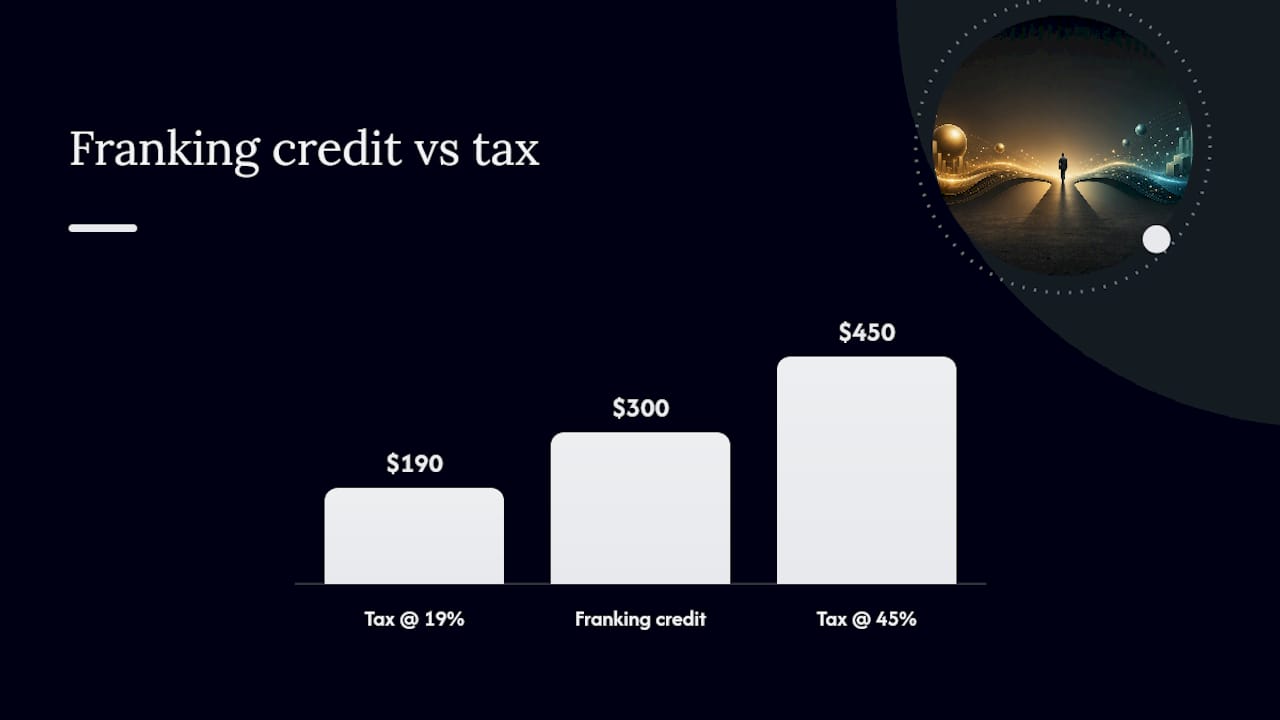
Say you hold shares that pay a fully franked dividend. At a 30% company tax rate, the attached franking credit is proportional to the dividend amount, and your assessable income from that dividend includes both the cash dividend and the franking credit combined.
Follow this sequence to work out your own position:
- Add the cash dividend and franking credit to get your grossed-up assessable income ($700 + $300 = $1,000).
- Apply your marginal tax rate to that grossed-up figure. At a 19% marginal rate, tax payable on the $1,000 is $190.
- Subtract the franking credit ($300) from that tax liability as your offset.
- Read the result. Because $300 exceeds the $190 owed, you get a $110 refund on this dividend alone.
At a 45% marginal rate, the same $1,000 grossed-up income attracts $450 in tax, leaving $150 still payable after the $300 offset is applied. The credit is worth the same $300 either way. What changes is whether it wipes out your liability, reduces it, or converts to cash in your pocket.
That gap between a refund and a residual bill is the entire logic behind a franking credits strategy: the same dividend delivers wildly different after-tax outcomes depending on who holds it.
Who can actually claim franking credits?
Not every investor gets the same value from a franked dividend, and eligibility hinges on residency, entity type, and how long you've held the shares.
Residency is the gatekeeper. You generally need to be an Australian tax resident to claim the franking tax offset or a refund. Non-residents typically can't claim franking credits at all, since they aren't subject to Australian income tax on those dividends in the same way.
Entity structure changes the payoff substantially:
- Individuals on lower marginal tax rates often receive cash refunds, since their tax liability is lower than the credit attached.
- SMSFs in accumulation phase pay 15% tax, so franking credits (calculated at a 30% company rate) usually exceed that liability and produce a refund.
- SMSFs in pension phase frequently pay zero tax on earnings, meaning the entire franking credit converts to a refundable cash amount.
- Trusts and partnerships distribute franking credits to beneficiaries or partners, who then claim them according to their own tax position.
Before relying on any of this, check the fundamentals: the 45-day holding period rule, the related payments rule, and the $5,000 small shareholder exemption that waives the holding rule for smaller portfolios. Complex trust or partnership structures warrant a conversation with a tax adviser rather than a guess.
Valuing franking credits when picking shares or ETFs
Cash yield alone understates what a fully franked dividend is actually worth to you. The number that matters is the grossed-up yield, calculated as cash yield divided by (1 minus the company tax rate), which for most ASX companies means dividing by 0.7.
Take a stock trading at $20 with a $1 fully franked annual dividend. The cash yield is 5%. Gross that up and the yield becomes roughly 7.14%, the figure that reflects your actual pre-tax equivalent return once the franking credit is factored in. According to WealthWorks' analysis of ASX dividend investing, this gap between cash and grossed-up yield is what changes the ranking between two otherwise similar dividend stocks once you account for your own tax position.
Whether that gap matters to you depends on your circumstances:
- Franking adds real value if you're in a low tax bracket, sitting in SMSF pension phase, or comparing two fully franked options against each other.
- Franking matters less if you're on the top marginal rate, since your offset barely dents your liability, or if you're a foreign investor who can't claim the credit at all.
Run the franking credit calculator against your own marginal rate before assuming a higher headline yield is actually the better deal.
Practical strategies to maximise the value of your franking credits
Getting the theory right is one thing. Building a portfolio around it is another. These are the tactics that actually move the needle.
Structural moves:
- Hold heavily franked shares inside an SMSF in pension phase or under a lower-income household member's name, where the offset is more likely to convert to a refund.
- Use dividend reinvestment plans (DRPs) on fully franked stocks. Reinvesting the cash dividend while still claiming the attached credit compounds your effective return over time, a point WealthWorks highlights as one of the more underused levers in long-term dividend investing.
- Favour fully franked blue-chips for the core of an income sleeve, and treat ETFs that pass through franking credits (rather than absorbing them at the fund level) as a genuine alternative to stock-picking.
When structure gets complicated, an SMSF makes sense once your balance justifies the running costs and you specifically want pension-phase refund treatment. A family trust can help distribute franking credits to the lowest-taxed beneficiary in a household, but it adds administrative overhead that isn't worth it for smaller portfolios. A standard company structure, by contrast, is often the worst place to hold dividend income for franking purposes, since companies don't get the same personal tax offset treatment individuals do.
Timing and operations matter more than most investors expect. Buying right before an ex-dividend date and selling shortly after can trigger a failure of the 45-day holding rule, and multiple parcel purchases complicate things further. The ATO applies a last-in, first-out assumption when you've bought the same stock more than once, which can quietly disqualify a parcel you assumed was compliant, according to Brown Hamilton's strategic guide on franking credit refunds. Review your holdings quarterly rather than just at tax time, particularly in the lead-up to 30 June.

Risk considerations shouldn't be an afterthought. Chasing franking credits too aggressively concentrates a portfolio in a handful of high-yield sectors, typically banks and miners, at the expense of diversification. The ATO's streaming rules also exist specifically to stop companies from directing franked dividends only to shareholders who can use the credits, so don't assume every arrangement that looks clever is compliant.
Pro Tip: Set a calendar reminder for your ex-dividend dates each quarter. Missing the 45-day window by even a few days on a large parcel can cost you thousands in disqualified credits.
Common mistakes and record-keeping habits that protect your refund
Most lost franking credits come down to timing errors, not bad luck. Buying shares just before a dividend and selling immediately after, sometimes called dividend washing, can breach the holding period rule and forfeit the offset entirely. Multiple parcel purchases trigger LIFO assumptions that can catch out investors who assumed their oldest shares counted first.
Keep these records without fail:
- Every dividend statement, showing cash amount, franking credit, and date paid
- Purchase and sale contract notes for each parcel, to prove holding periods
- Trust or partnership distribution statements if credits flow through an entity
The small shareholder exemption removes the 45-day rule if your total franking credits for the year sit under $5,000, but it doesn't exempt you from the related payments rule, which still applies regardless of portfolio size, as outlined in the ATO's franking tax offset guidance.
Modelling your franking credit strategy with AlphaIQ
Reading the rules is one thing. Seeing what they mean for your actual portfolio is another, and that's where scenario modelling earns its keep.
Consider a simplified comparison: an individual on a 32.5% marginal tax rate holding $50,000 in fully franked ASX shares versus the same holding inside an SMSF in pension phase. The individual's franking credits offset most of their liability on that income but leave some tax payable. The SMSF pension phase holder, paying zero tax on earnings, converts the entire credit into a refund.
Running that comparison yourself takes three steps:
- Input your holdings and dividend profile, including franking percentages and payment frequency.
- Set your entity and tax status, whether that's an individual marginal rate, SMSF accumulation, or SMSF pension phase.
- Run the scenario and compare after-tax returns, ideally across multiple years to see how compounding through a DRP changes the outcome.
AlphaIQ's scenario simulation can model marginal tax outcomes, Medicare levy interactions, and franking credit refunds across entity types, showing the net cash effect of a dividend strategy over a rolling five-year horizon rather than a single tax year snapshot.
This is modelling guidance, not personalised tax advice. Structural changes like setting up an SMSF or trust warrant a conversation with a qualified tax adviser first.
Estimating your actual refund or liability from franking credits
The practical way to estimate this for your own portfolio: take your total expected franked dividend income for the year, gross it up by dividing by 0.7, then apply your marginal tax rate to that grossed-up figure. Subtract the franking credits already embedded in that grossed-up amount. What's left is either a residual tax bill or, if the credits exceed the liability, a refund.
This calculation gets more complicated once you factor in the Medicare levy, other income sources pushing you into a higher bracket, or capital gains realised in the same year. A $20,000 fully franked dividend portfolio might land you comfortably under your tax-free threshold in one year and push you into a higher bracket the next, simply because you sold an investment property or received a bonus. That's why a single static calculation done once a year understates the real planning opportunity. Running the numbers through the franking credits calculator each time your income picture shifts gives a far more accurate read than a once-a-year estimate based on last year's numbers.
Building a portfolio model to test different franking scenarios
Once you understand the mechanics, the next step is testing how different asset allocations actually perform after tax, not just on paper yield.
Start by mapping your current holdings against their franking percentages. A portfolio that looks diversified on a sector basis might be surprisingly concentrated in fully franked payers if you've leaned heavily into banks and miners, which tend to carry the highest franking rates on the ASX.
From there, build out scenarios that vary three inputs: entity structure, holding mix, and reinvestment approach. Compare a scenario where dividends are taken as cash against one where they're reinvested through a DRP. Compare an all-individual holding structure against splitting the portfolio between an SMSF and a lower-income spouse. Each combination produces a different after-tax return, and the differences compound meaningfully over five or ten years, particularly once dividend reinvestment is factored in.
The investment strategy examples for Australians worth reviewing show how these allocation decisions interact with broader portfolio goals, not just tax minimisation in isolation. A franking-heavy allocation might optimise your tax outcome while leaving you overexposed to a handful of sectors, so any modelling exercise needs to weigh after-tax yield against diversification and growth potential together.
Retirees and those approaching preservation age face an added layer, since the tax treatment of income inside super shifts again once you reach pension phase. The retirement tax strategies guide covers how franking credit refunds interact with super drawdown planning, which matters if you're modelling a transition from accumulation to pension phase in the next few years.
Why franking credits shouldn't drive your whole strategy
Franking credits are a genuine tax benefit, not a reason to build a portfolio. I've seen investors chase fully franked yield into a handful of bank and mining stocks and call it a strategy, when really it's concentration risk wearing a tax-efficient disguise.
Treat the franking benefit as one component of total return, not the goal itself. A few rules of thumb:
- Prefer stable, long-term dividend payers over high-yield stocks that only look attractive once grossed up.
- Recheck your structure annually, since marginal tax rates and super phases change as income and age shift.
- Never let a tax offset override a genuine diversification or liquidity need.
Turn the theory into numbers with AlphaIQ
Working through gross-up calculations and entity comparisons by hand is where most investors give up on a franking credits strategy before they've actually tested one. AlphaIQ removes that friction by modelling your dividend income, franking credits, and entity tax status together, so you see the actual refund or liability outcome rather than estimating it.

The platform maps your holdings against your tax position and runs scenario comparisons across individual, SMSF accumulation, and SMSF pension phase structures, showing you the after-tax yield difference before you make a single trade. If you're weighing whether an SMSF pension phase structure would meaningfully improve your refund position, or whether reinvesting through a DRP compounds faster than taking dividends as cash, AlphaIQ's wealth intelligence platform runs that comparison using your actual numbers, not generic assumptions. Start a trial and model your own portfolio against the scenarios covered in this guide before you adjust a single holding.
Frequently asked questions
Can I claim franking credits if I'm a non-resident? Generally no. Franking credit refunds are available to Australian tax residents; non-residents typically can't claim the offset on Australian dividends.
What happens if my total franking credits are under $5,000? The small shareholder exemption waives the 45-day holding rule below that threshold, though the related payments rule still applies regardless of portfolio size.
Do ETFs pass through franking credits the same way as direct shares? Most Australian equity ETFs pass franking credits through to unit holders, but the mechanism varies by fund structure, so check the product disclosure statement.
Is an SMSF worth setting up purely for franking credit refunds? Rarely on that basis alone. SMSF running costs need to be justified by overall balance and strategy, with franking refunds as one factor among several.
How does the 45-day rule interact with multiple share purchases? The ATO applies a last-in, first-out assumption, so your most recent purchase is treated as the parcel sold first, which can affect whether older parcels still qualify.
This article is general information, not a substitute for advice from a qualified financial advisor. Consult a qualified financial professional about your own circumstances before acting on anything here.
Sources
Check the ATO's franking tax offset rules and its page on refunds of franking credits for individuals for the primary rules governing your circumstances.
- Franking tax offsets | Australian Taxation Office
- ASX Dividend Investing and Franking Credits: A Complete Guide for Australian Investors in 2026 | WealthWorks
- Maximising Franking Credit Refunds: 2026 Strategic Guide
Always confirm specific rules against your own circumstances, and use AlphaIQ modelling to apply them numerically.