
ETFs create taxable events two ways: the fund can distribute realised capital gains to you even if you never sell, and you trigger your own gain or loss when you sell your shares. Sales are taxed as short- or long-term capital gains depending on how long you held them, while distributions arrive as dividend or capital gains statements. Most equity ETFs are tax-efficient thanks to in-kind redemptions, but exceptions exist, and everything ultimately flows through your 1099 forms and Schedule D.
TL;DR:
- Short-term gains are taxed at ordinary income rates if ETFs are held for 12 months or less, while long-term gains benefit from lower, preferential rates after 12 months.
- Capital gains distributions from ETFs are taxed in the year they are paid, regardless of your personal holding period, and may include return-of-capital adjustments that lower your cost basis.
- ETFs typically generate fewer taxable gains than mutual funds because of in-kind redemptions, but actively managed, commodities, futures, or specialized funds may produce different tax implications.
- Proper record-keeping of purchase dates, reinvested dividends, and cost basis adjustments is crucial for accurate reporting and effective tax planning.
- Timing your sales to maximize long-term holding and employing strategies like tax-loss harvesting can significantly reduce your overall tax burden.
Table of Contents
- How ETFs create taxable events: distributions, cost base and sales
- Are ETF gains taxed differently short-term vs long-term?
- Why are ETFs more tax-efficient than mutual funds?
- What tax forms do you need for ETF capital gains?
- What are the best tax strategies for ETF investors?
- How scenario modelling clarifies ETF tax outcomes
- Primary reading: IRS, SEC and policy analysis
- Editorial take: what actually matters for ETF investors
- Sources
- FAQ
How ETFs create taxable events: distributions, cost base and sales
Two different mechanisms drive capital gains on ETFs, and conflating them is where most investors get confused.
The first is a capital gains distribution. This happens when the fund itself sells underlying holdings, perhaps to rebalance an index or meet redemptions, and passes the realised profit through to every shareholder of record. You owe tax on that distribution whether you've held the ETF for ten years or ten days, and whether you reinvest it or take it as cash.
The second is a sale. When you sell your ETF shares, you calculate your own gain or loss based on what you paid (your cost base) versus what you received.
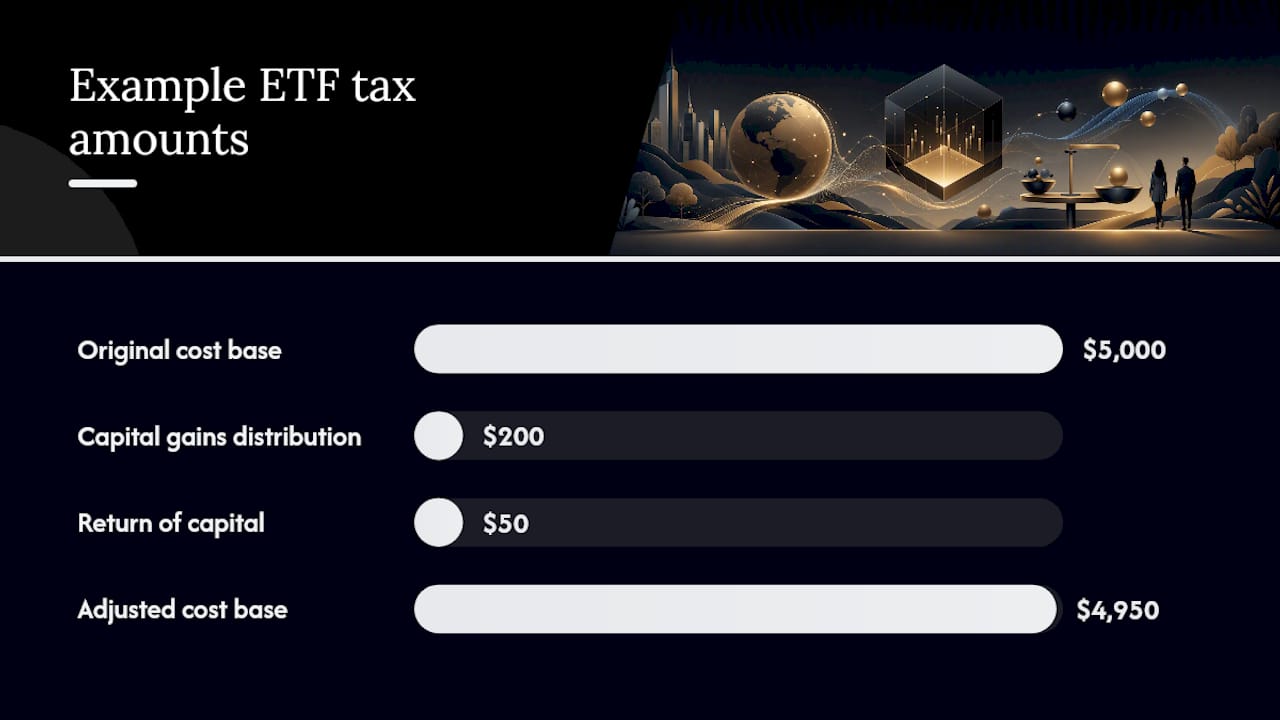
Cost base isn't always static, either. Some distributions include a "return of capital" component that lowers your cost base rather than counting as immediate income, deferring tax until you sell. This matters because it changes your eventual gain.
A quick example: you buy 100 units of an ETF at $50 each, for a $5,000 cost base. The fund pays a $200 capital gains distribution that year, and $50 of it is classified as return of capital. That $50 doesn't get taxed now, but it reduces your cost base to $4,950.
- Capital gains distributions are taxed in the year they're paid, regardless of your holding period.
- Return-of-capital adjustments lower your cost base and defer tax until you sell.
- Selling shares triggers a separate, independent taxable event based on your adjusted cost base.
Funds may pass through realised capital gains as distributions even when you haven't sold a single unit, which is why checking your annual statements matters as much as tracking your own trades.
Are ETF gains taxed differently short-term vs long-term?
Yes, and the gap between the two is significant enough to change your selling decisions.
If you hold an ETF for 12 months or less before selling, any profit counts as a short-term capital gain, taxed at your ordinary income rate. Hold it for more than 12 months and it becomes a long-term capital gain, taxed at the preferential rates of 0%, 15%, or 20%, depending on your taxable income.
The rate gap in practice: A $10,000 gain taxed at a 32% ordinary rate costs $3,200. The same gain held past 12 months and taxed at 15% costs $1,500. That's $1,700 saved for waiting a matter of weeks.
High earners face an added layer: the Net Investment Income Tax adds 3.8% on top of capital gains for individuals with modified adjusted gross income above $200,000 (or $250,000 for joint filers). That pushes the top effective long-term rate to 23.8% for some investors.
Capital gains distributions from the fund are usually already classified as long-term, regardless of how long you've personally owned the ETF, because the fund reports the character of the underlying gain it realised. Your own sale is judged separately, against your own purchase date.
Why are ETFs more tax-efficient than mutual funds?
ETFs generally generate fewer capital gains distributions than mutual funds because of a structural quirk called in-kind redemption. When large investors want to cash out of an ETF, the fund manager can hand over a basket of underlying securities instead of selling them on the open market. That mechanism avoids realising gains at the fund level, which is the main reason plain-vanilla index ETFs so rarely issue year-end capital gains distributions compared with traditional mutual funds.
That efficiency isn't universal, though. Several structures break the pattern:
- Actively managed ETFs trade more often, which can still generate fund-level gains despite the ETF wrapper.
- Large, unusual redemptions can occasionally force a fund to sell assets outright rather than transfer them in-kind.
- Commodity and precious metals ETFs are frequently taxed as collectibles, at a maximum rate of 28%, regardless of your normal capital gains bracket.
- Futures-based ETPs often use 60/40 tax treatment, splitting gains between short-term and long-term regardless of holding period, and may issue a Schedule K-1 instead of a standard 1099.
- ETNs and foreign or crypto-linked funds can carry their own reporting quirks, including K-1s or PFIC-style rules.
Check a fund's tax statements and prospectus before assuming it will behave like a standard equity ETF. Past distribution history is usually your best clue.
What tax forms do you need for ETF capital gains?
Your broker sends two forms that carry almost everything you need. Form 1099-DIV reports ordinary dividends and capital gains distributions the fund paid you, even if you never sold. Form 1099-B reports proceeds from any ETF shares you actually sold, along with your cost base if the broker tracked it.
Here's how those figures move onto your tax return:
- Capital gains distributions from your 1099-DIV get entered directly on Schedule D, no separate calculation required.
- Sales reported on your 1099-B get listed on Form 8949, sorted by short-term and long-term, then totalled onto Schedule D.
- Any adjustments, like wash sales or cost base corrections your broker flagged, get coded on Form 8949 before the totals carry over.
For the underlying rules, the IRS Publication 550 covers investment income generally, while Publication 598 addresses unrelated business income issues that occasionally affect specialised funds.
Keep your own records regardless of what your broker sends. Purchase dates, reinvested distribution amounts, and cost base adjustments matter most for older holdings, where brokers sometimes have incomplete data, especially if you've moved accounts or the ETF has undergone a corporate action.
What are the best tax strategies for ETF investors?
None of these strategies eliminate tax on ETF gains, but used deliberately, they can meaningfully change how much you pay and when.
Specific identification lets you choose which lot of shares to sell when you own multiple purchases of the same ETF at different prices. Selling your highest-cost, longest-held lot first can shrink your taxable gain compared with the default first-in-first-out method most brokers apply automatically.
Tax-loss harvesting offsets realised gains with realised losses elsewhere in your portfolio. Net losses beyond your gains can offset up to $3,000 of ordinary income per year, with any excess carried forward indefinitely to future tax years.
Account placement matters more than most investors realise. Holding your most tax-inefficient ETFs, commodity funds, actively managed funds, anything prone to distributions, inside a 401(k) or IRA defers or eliminates the tax drag entirely, while buy-and-hold index ETFs can sit comfortably in a taxable account.
- Time large purchases to avoid buying an ETF right before its annual distribution date, a mistake known as "buying the distribution."
- Track cost base changes from reinvested dividends; each reinvestment creates a new, separate lot with its own purchase date.
- Watch for wash-sale risk if you sell an ETF at a loss and buy a substantially identical fund within 30 days, which disallows the loss.
- Review carry-forward rules for capital losses each year rather than assuming unused losses expire.
Pro Tip: Run the numbers before you sell, not after. Modelling a sale against your cost base and current bracket, the way you'd approach tax gain harvesting, often reveals that waiting a few weeks for long-term treatment saves more than any single deduction you could claim.
How scenario modelling clarifies ETF tax outcomes
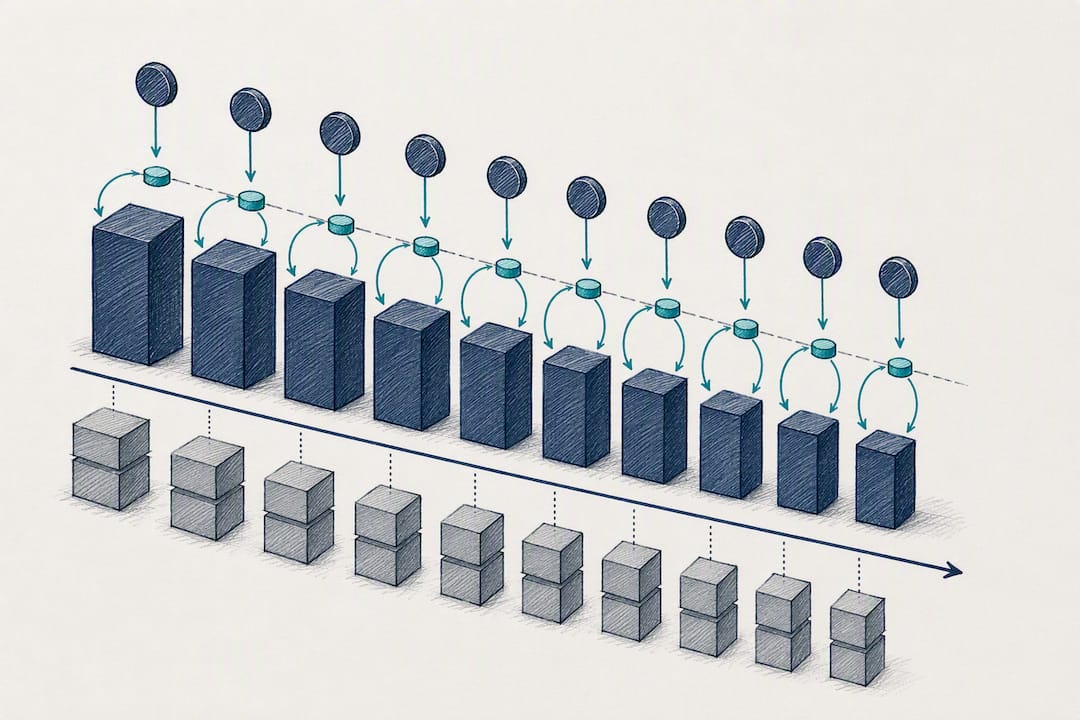
Understanding the mechanics on paper is one thing. Seeing how repeated distributions, reinvestments, and cost base adjustments compound over a decade is another. Tax-aware modelling exposes that long-run drag clearly, showing how a fund that seems tax-efficient in any single year can still erode returns steadily if you never sell and never adjust course.
That kind of scenario testing is useful for anticipating outcomes. It is not a substitute for filing help. Always validate model outputs against your actual 1099 forms with a CPA before you lodge, particularly if you hold specialised ETPs with K-1 or collectibles treatment.
Primary reading: IRS, SEC and policy analysis
- IRS Publication 550 on investment income
- SEC investor bulletin on fund taxation
- Brookings analysis on reform proposals
Editorial take: what actually matters for ETF investors
Most guidance on capital gains on ETFs treats the topic as a compliance checklist: know your forms, know your rates, done. That undersells the real lever, which is timing.
The 12-month threshold between short- and long-term treatment is the single biggest number in this entire topic, and it's the one investors override most casually when they panic-sell or chase a rebalance. The mechanics of in-kind redemption and cost base adjustment matter, but they're background conditions you can't control. Your holding period is the one variable you actually manage.
Policy debate around how pooled funds get taxed is genuinely active, and any investor building a ten-year plan around today's ETF tax treatment should hold that plan loosely. Rules shift.
My honest read: model your holding period and cost base before you touch a sell button, treat every "tax-efficient" label as a historical observation rather than a guarantee, and get a CPA to sign off before you file anything unusual.
— Jonathan
Sources
- About Publication 550 (Investment Income and Expenses) — IRS
- Fund trading and taxation — SEC investor bulletin
- Taxing index funds: Mutual funds, ETFs, and paths to reform — Brookings
FAQ
How Are ETF Capital Gains Taxed?
Sales are taxed as short-term (ordinary income rates) if held 12 months or less, or long-term (0%, 15%, or 20%) if held longer. Fund-level capital gains distributions are taxed in the year paid, separate from your own holding period.
How Can You Avoid Capital Gains Tax on an ETF?
You can't avoid it entirely, but holding shares longer than 12 months for long-term rates, using tax-loss harvesting to offset gains, and holding tax-inefficient ETFs inside a 401(k) or IRA all reduce the tax you actually pay.
Is There a Tax Loophole for ETFs?
Not a loophole exactly. ETFs benefit from a legal structural mechanism, in-kind redemption, that lets fund managers avoid triggering fund-level capital gains when large investors redeem shares, which is why many ETFs distribute fewer taxable gains than comparable mutual funds.
What Did Warren Buffett Say About ETFs?
Buffett has long recommended low-cost index funds, including index-tracking ETFs, for most individual investors, arguing that consistent, low-fee, broad-market exposure beats most active stock-picking over time.
Do You Pay Tax on ETF Dividends?
Yes. ETF dividends are reported on Form 1099-DIV and taxed either as ordinary income or at qualified dividend rates, depending on how the underlying payments are classified.