
TL;DR:
- Direct share investing involves owning individual Australian stocks registered in your name, offering control over buying, selling, and tax benefits. It requires disciplined research, diversification, and regular portfolio management to maximize tax advantages and reduce risks. Starting with a CHESS-sponsored broker account and a core-satellite strategy ensures legal ownership and balanced growth.
Direct share investing is defined as buying and holding shares of individual listed companies registered in your own name, giving you direct legal ownership rather than a pooled interest through a managed fund or ETF. This approach, sometimes called direct equity investing, puts you in control of which companies you own, when you buy or sell, and how you manage the tax consequences. For Australians aged 30 to 55 building personal wealth, understanding the mechanics of this model, including ASX's CHESS sponsorship system, Holder Identification Numbers, and direct stock purchase plans, is the foundation for making confident investment decisions.
What is direct share investing and how does it work in Australia?
Direct share investing means buying shares of individual listed companies and holding them in your own name on the share register, rather than through a pooled vehicle where a fund manager makes decisions on your behalf. In Australia, this is typically done through a brokerage account or, less commonly, through a company-run direct stock purchase plan. The distinction matters because ownership structure determines your legal rights, your tax position, and your exposure to counterparty risk.

How CHESS sponsorship and your HIN work
When you open a standard brokerage account in Australia and buy shares on the ASX, your holdings are registered through the CHESS system, which stands for Clearing House Electronic Subregister System. CHESS assigns you a Holder Identification Number, or HIN, which links your name directly to the shares on the ASX sub-register. This means you are the legal owner of record, not your broker. If your broker were to collapse, your shares remain yours. This is a meaningful protection that custodian models, where shares are held in the broker's name on your behalf, do not always provide.
Placing orders and settlement timing
Once your brokerage account is active, you place buy orders using either a market order or a limit order. Market orders execute at the best available price immediately, while limit orders let you specify the maximum price you are willing to pay. Limit orders give you more control but may not execute if the price does not reach your target. In Australia, standard ASX equity trades settle on a T+2 basis, meaning the transaction is finalised two business days after the trade date.
Pro Tip: Always use a CHESS-sponsored account rather than a custodian model when starting out. The HIN arrangement gives you cleaner legal ownership and makes it simpler to transfer your portfolio between brokers without selling your shares.
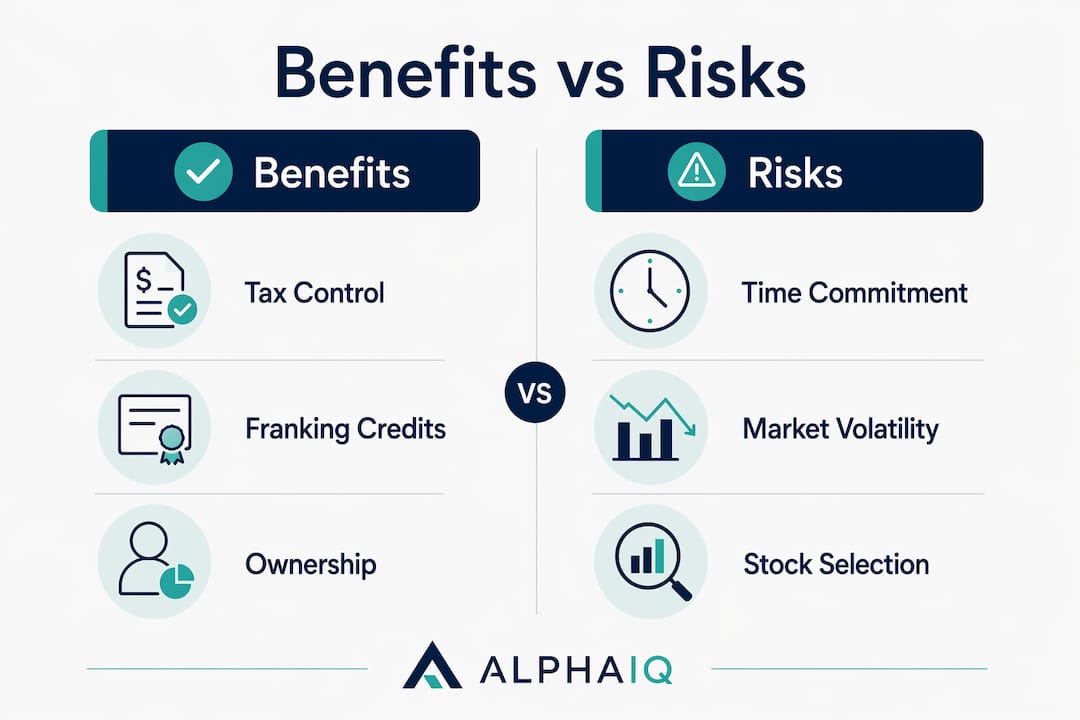
What are the benefits and risks of direct share investing?
Direct equities give investors the highest degree of tax control compared with managed funds or ETFs. You decide when to realise capital gains, which means you can time sales to align with your marginal tax rate, offset gains against losses, or hold shares for more than twelve months to access the 50% capital gains tax discount. Managed funds, by contrast, can distribute capital gains to you even when you have not sold a single unit, creating a tax liability you did not choose.
Franking credits are another advantage unique to Australian direct share investors. When Australian companies pay dividends from already-taxed profits, they attach franking credits that reduce your personal tax liability. Holding shares directly means you receive those credits in full and can use Alphaiq's franking credit calculator to model the true after-tax yield of dividend-paying stocks before you commit capital.
The risks are equally real. Direct share investing requires ongoing time and discipline to select stocks, track performance, manage corporate actions such as rights issues and dividend reinvestment plans, and maintain adequate diversification. Concentration risk is the most common pitfall: holding five or six stocks in similar sectors exposes your portfolio to a single industry downturn in a way that a diversified ETF does not.
| Factor | Direct shares | Managed funds and ETFs |
|---|---|---|
| Tax control | High. You choose when to realise gains. | Low to medium. Fund distributions can trigger tax. |
| Franking credits | Received directly and in full. | Passed through but may be diluted or delayed. |
| Diversification | Requires active management and capital. | Built in from day one. |
| Ongoing fees | Brokerage per trade, no management fee. | Annual management expense ratio applies. |
| Time commitment | High. Research and monitoring required. | Low. Fund manager handles decisions. |
| Ownership clarity | Direct legal ownership via CHESS and HIN. | Beneficial interest in a pooled structure. |
Pro Tip: Tax planning is often the biggest hidden lever in direct share investing. Reviewing your unrealised gains and losses before 30 June each year can meaningfully improve your after-tax return without changing a single stock in your portfolio.
What are direct stock purchase plans, and how do they differ from broker investing?
Direct stock purchase plans, or DSPPs, allow you to buy shares directly from a company or its transfer agent without using a broker. Some plans offer shares at a small discount to market price and allow recurring automatic purchases with low minimum amounts. For long-term investors focused on accumulation rather than active trading, DSPPs can reduce transaction costs and encourage consistent investing habits.
The trade-offs are significant, however. DSPPs are less common in Australia than in the United States, and the companies that offer them tend to be large, established names. Execution is slower because purchases are processed at set intervals rather than in real time. You also have less flexibility to respond to market movements or corporate events quickly.
Key features and limitations of DSPPs include:
- No broker required. Shares are purchased directly through the company or a transfer agent.
- Possible price discounts. Some plans offer shares at a small discount to the prevailing market price.
- Recurring investment options. Automatic periodic purchases support disciplined accumulation.
- Slower execution. Trades are batched and processed at intervals, not in real time.
- Limited company selection. Not all ASX-listed companies offer DSPPs, restricting your choices.
- Less flexibility. Selling shares or responding to market events is slower than via a brokerage account.
For most Australian investors, a CHESS-sponsored brokerage account offers greater flexibility, broader company access, and faster execution. DSPPs suit a specific use case: building a position in a single company over time with minimal transaction friction.
How to build a direct share portfolio: strategies and practical steps
Building a direct share portfolio that performs over the long term requires more than picking good companies. It requires a structured approach to timing, diversification, and cost management. The following steps give you a practical framework to start and sustain a direct share portfolio.
-
Open a CHESS-sponsored brokerage account. Choose a broker that offers full CHESS sponsorship so your shares are registered in your name with a HIN. Compare brokerage fees per trade, as these costs compound over time.
-
Start with a core and satellite structure. A blended approach using diversified ETFs as your core holding and direct shares as satellite positions reduces concentration risk while preserving the tax and ownership benefits of direct investing. Your ETF core provides broad market exposure; your direct shares allow targeted positions in companies you understand well.
-
Invest on a recurring schedule. Setting a fixed monthly or quarterly investment amount removes the pressure of timing the market. Recurring investments mean you buy more shares when prices are lower and fewer when prices are higher, averaging your entry cost over time.
-
Research before you buy. Direct share investing requires you to understand the businesses you own, including their revenue model, competitive position, and financial health. Reviewing annual reports, ASX announcements, and analyst summaries builds the knowledge base you need to hold shares with conviction during market downturns.
-
Track and rebalance regularly. Review your portfolio at least twice a year. Check whether any single stock has grown to represent more than 10 to 15 percent of your total portfolio value, and consider trimming to manage concentration risk. Use this review to also assess portfolio diversification strategies and whether your current mix still reflects your goals.
Pro Tip: Direct share investing avoids ongoing fund management fees, but brokerage costs per transaction add up quickly if you trade frequently. Aim to hold positions for the long term and batch smaller purchases where possible to keep transaction costs proportionate to your investment size.
Key takeaways
Direct share investing gives Australian investors legal ownership, tax control, and franking credit access that pooled vehicles cannot fully replicate, but it demands discipline, diversification, and ongoing research to deliver those benefits.
| Point | Details |
|---|---|
| Ownership via CHESS and HIN | CHESS-sponsored accounts register shares in your name, providing direct legal ownership and stronger investor protection. |
| Tax control is the key advantage | You choose when to realise capital gains and receive franking credits in full, improving after-tax returns. |
| DSPPs suit long-term accumulators | Direct stock purchase plans offer low-cost recurring investment but lack the flexibility of a brokerage account. |
| Core and satellite portfolio structure | Combining diversified ETFs with direct shares balances broad market exposure and targeted ownership benefits. |
| Discipline and research are non-negotiable | Ongoing stock monitoring, rebalancing, and behavioural consistency determine outcomes more than initial stock selection. |
Direct share investing: what experience actually teaches you
I have spent years working with Australian investors who come to direct share investing with high expectations and a reasonable amount of capital, and the pattern I see most often is this: the mechanics are learned quickly, but the discipline takes much longer to develop.
The tax advantages of direct shares are genuinely significant, and they are consistently underutilised. Most investors I encounter have never sat down before 30 June to review their unrealised losses or modelled the after-tax impact of holding a stock for twelve months versus selling at eleven. That single habit, reviewing your tax position annually, can add more to your net return than picking a better stock.
The other thing that surprises people is how much behavioural discipline direct share investing demands. Holding a stock through a 20 percent drawdown when you own it directly feels very different from watching your ETF portfolio fall by the same amount. You know the company name. You read the announcement. The emotional weight is heavier, and that weight causes investors to sell at exactly the wrong time.
My honest view is that direct share investing is not a substitute for diversification management. It is a complement to it. The investors who do best are those who treat direct shares as a deliberate, researched satellite alongside a diversified core, not as a replacement for one. Start small, build your knowledge alongside your portfolio, and use every tool available to model your tax and retirement outcomes before making decisions.
— Jonathan
How Alphaiq supports your direct share investing decisions
Alphaiq is built for Australian investors who want to take control of their financial position with real numbers rather than guesswork.

If you are building a direct share portfolio, Alphaiq's wealth intelligence platform gives you the modelling tools to understand your capital gains exposure, calculate the true after-tax value of franked dividends, and project how your investments interact with your superannuation and retirement timeline. The superannuation calculator lets you model how direct share returns feed into your broader retirement position, so you can make investment decisions with full visibility of the long-term picture. No ongoing advice fees. No guesswork. Just clarity.
FAQ
What is the difference between direct shares and ETFs?
Direct shares give you legal ownership of individual company stock registered in your name, while ETFs hold a basket of securities in a pooled structure. Direct shares offer greater tax control and full franking credit access, but require more research and active management.
Do I need a broker to invest in shares directly in Australia?
Most Australian investors use a CHESS-sponsored brokerage account to buy shares on the ASX. Some companies offer direct stock purchase plans that bypass brokers, but these are less common in Australia and offer slower execution and fewer company choices.
What is a HIN and why does it matter?
A Holder Identification Number, or HIN, is assigned to you through the ASX CHESS system when you open a CHESS-sponsored brokerage account. It registers your shares in your name on the ASX sub-register, confirming your direct legal ownership and protecting your holdings if your broker fails.
What are franking credits and how do they benefit direct share investors?
Franking credits are tax offsets attached to dividends paid by Australian companies from already-taxed profits. Direct share investors receive these credits in full and can use them to reduce their personal tax liability, making dividend-paying Australian stocks particularly tax-efficient for investors in lower or middle tax brackets.
Is direct share investing suitable for beginners?
Direct share investing suits investors who are willing to research companies, monitor their portfolio regularly, and maintain discipline during market downturns. Beginners often benefit from starting with a small satellite allocation of direct shares alongside a diversified ETF core, building knowledge and confidence before increasing their direct share exposure.